Between de Nes, Hasselt, and Paris:
New Light on the Hidden Family History of Fortepiano Maker Louis II Dulcken
In later music lexicons, the early life of the renowned fortepiano maker Louis II Dulcken (baptized as Jan Lodewijk on August 9, 1761) is often presented concisely and somewhat selectively. These reference works almost certainly rely on Dulcken’s own account: that he was born in Amsterdam and later moved to Paris from there.
In reality, Dulcken omitted quite a few chapters from his own historiography. As a baby of less than six months old, the family already left Amsterdam for Hasselt in Overijssel. In his later biography, he concealed both his childhood in this town in Overijssel (where he lived until his thirteenth year) and his subsequent period in Antwerp—even though his mother, sisters, and younger brother simply continued living in Hasselt. Recent archival discoveries in Amsterdam and Paris now uncover the complete, often dramatic reality behind these suppressed years.
1. The Discovery of the True Birth Address: de Nes (1761)
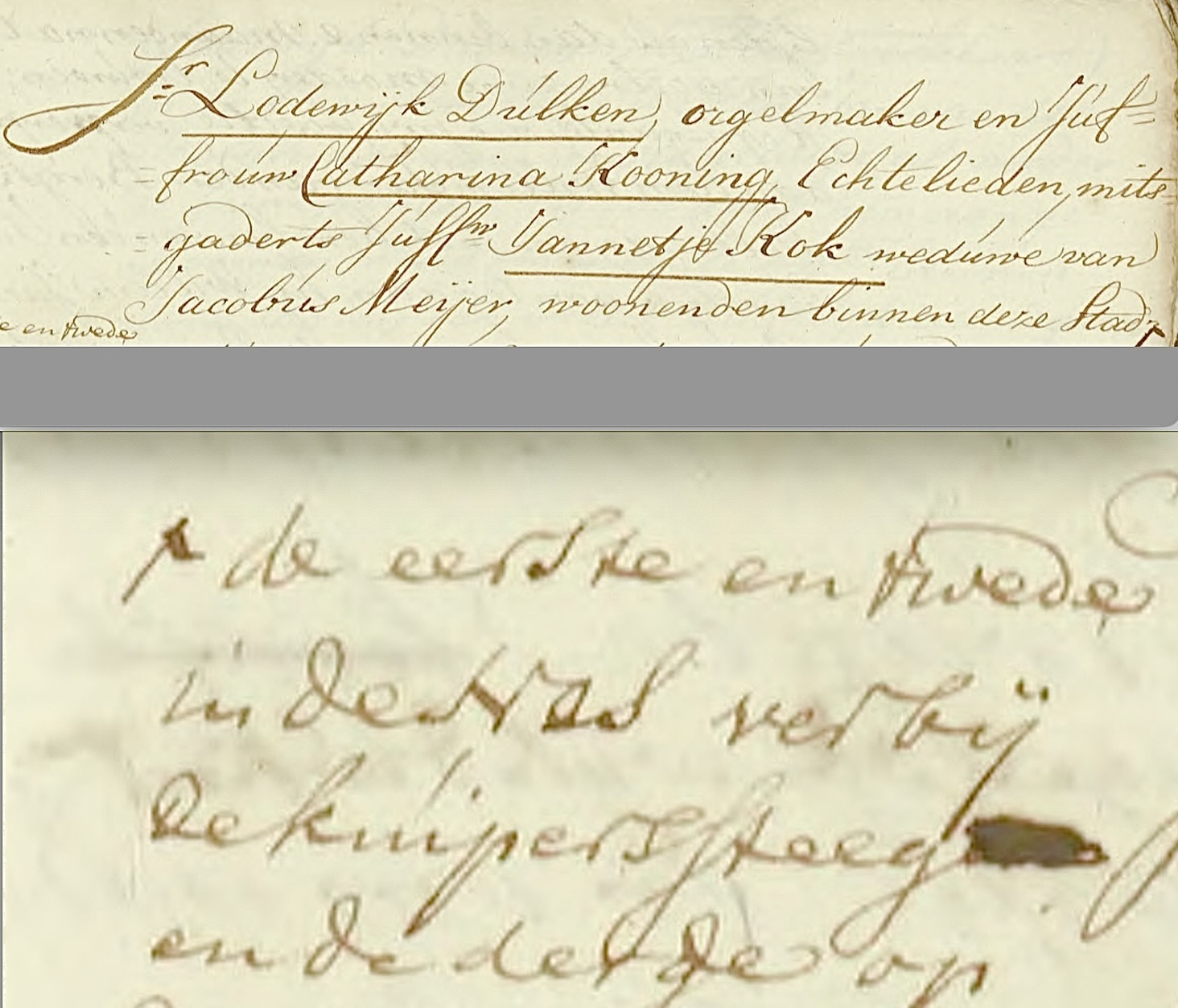
Although Dulcken largely kept his exact Amsterdam background out of view, a notarial deed dated June 11, 1761,drawn up by notary Kier van der Piet, now yields a fascinating new detail regarding his birthplace. Until now, based on newspaper advertisements by his father, organ builder Johan Lodewijk (Louis I) Dulcken, it was assumed that the family lived and worked in the Karthuizerstraat (next to the almshouse).
On June 11, 1761, however, the heavily pregnant Catharina Koning and her husband Johan Lodewijk appeared before the notary to give a testimony. The opening lines reveal that, in addition to the workshop in the Karthuizerstraat, the family had a separate residential address. This allows us to establish with certainty that Louis II Dulcken was born in de Nes, beyond the Kuiperssteeg.
2. The Willem Jan van den Bergh Affair and the Midwife
The reason for the visit to the notary was an ongoing conflict surrounding broker Willem Jan van den Bergh, who had fathered a child with the unmarried and underage Jacoba Geertruijd Thieri. Supported by her father, Bernardus Thieri, Jacoba demanded that Willem Jan honor his promise of marriage and wed her.
The involvement of the Dulcken couple raises intriguing questions about the social circles in which they moved in Amsterdam. Over a year earlier, on March 16, 1760, a baby boy (Willem Lodewijk) born to Willem Jan van den Bergh and Jacoba Geertruijd Thieri was baptized in the Westerkerk. None other than Lodewijk Dulcken and Catharina Koning acted as baptismal witnesses. The bond between the families proved lasting: at the baptism of Dulcken’s third child (Daniel Lodewijk), Anna Bernadine Thiry served as witness, presumably a sister of Jacoba.
The Dulckens’ testimony on June 11 did not stand alone. Two weeks earlier, on May 28, 1761, Willem Jan and the Thieri family had already faced each other before the same notary, and on July 16, 1761, midwife Amarensje de Broeker (residing on the Anjeliersgracht, present-day Anjeliersstraat) also gave an incriminating statement under oath.It revealed that shortly before the delivery, Willem Jan had tried to persuade the midwife to record a false father's name at the birth—which Jacoba flatly refused. Furthermore, on Wednesday, March 12, 1760, Willem Jan had personally attended the delivery on the Nieuwezijds Achterburgwal, held Jacoba during her labor pains, and stood present when she declared before the midwife that he was the father.
Despite the father's pressure and the sworn testimonies, Willem Jan refused to marry. Worse still, on January 16, 1763,Willem Jan had another illegitimate child baptized in the Oude Kerk (daughter Johanna Willemina, by Henderina van Wieringa). Willem Jan did not live much longer thereafter: on August 19, 1763, he was buried in Amsterdam. When his estate and list of debts were drawn up, one final notable name surfaced: there was only a single person who still owed money to the deceased Willem Jan—Johan Lodewijk Dulcken.
3. Catharina Koning and the Amsterdam Fiction: "Parents Dead" (1780–1795)
After the Amsterdam years, the family moved to Hasselt (Overijssel), while father Louis I Dulcken later continued his career in Antwerp and Paris. For the children who remained in the Dutch Republic, the distance from their parents grew ever wider—leading to remarkable contradictions in the Dutch marriage banns registers:
January 14, 1780: When daughter Susanna Maria Dulken registers her marriage banns in Amsterdam with the 42-year-old Willem van Hoesem, her mother Catharina Koning is still alive and well in Amsterdam to assist her daughter ("geassisteert met haar moeder Catharina Kooning"). No record of her death can be found in Amsterdam; she likely traveled to France later to rejoin her husband and died in Paris (after which Louis I remarried a certain Anna there).
April 17, 1795: When son Jan Dulken (born in Hasselt, Overijssel) registers his marriage banns in Amsterdam with Margaretha Koers, the clerk of the aldermen’s bench records bluntly and matter-of-factly that both parents are deceased ("ouders dood").
Was this bitter earnest or an administrative workaround? In the revolutionary year 1795, obtaining legally valid parental consent from Terror-stricken France was virtually impossible. By declaring his parents deceased, Jan was able to proceed with his marriage in Amsterdam without delay.
4. The Parisian Reality: Between Court Nobility and the Guillotine
That father Louis I Dulcken was in fact alive and well in 1795 is proven by an official Parisian deed dated August 31, 1795 (14 Fructidor Year III). In it, Louis Dulken, facteur de clavecin, residing at rue Martin et du Figuier N° 32, acts as surety for his wife (citoyenne Dulken). Moreover, at his own wedding in 1799 to Sophie Lebrun, son Louis II would proudly state that his father had been royal instrument maker at the court of Louis XVI.
That Parisian circle lived on a knife-edge during those years. A striking example is Johan Jacob Schnell (1740–1825),inventor of the anemochord, who had worked for six years as a journeyman in Dulcken's workshop in the Netherlands and also collaborated with Louis Dulcken in Antwerp before moving to Paris. Because of his ties to the French court (he was court instrument maker to the Countess of Artois), Schnell narrowly escaped the guillotine during the French Revolution; thanks to the decisive intervention of his wife, he managed to flee at the very last moment.
Appendix: Sources and Deeds
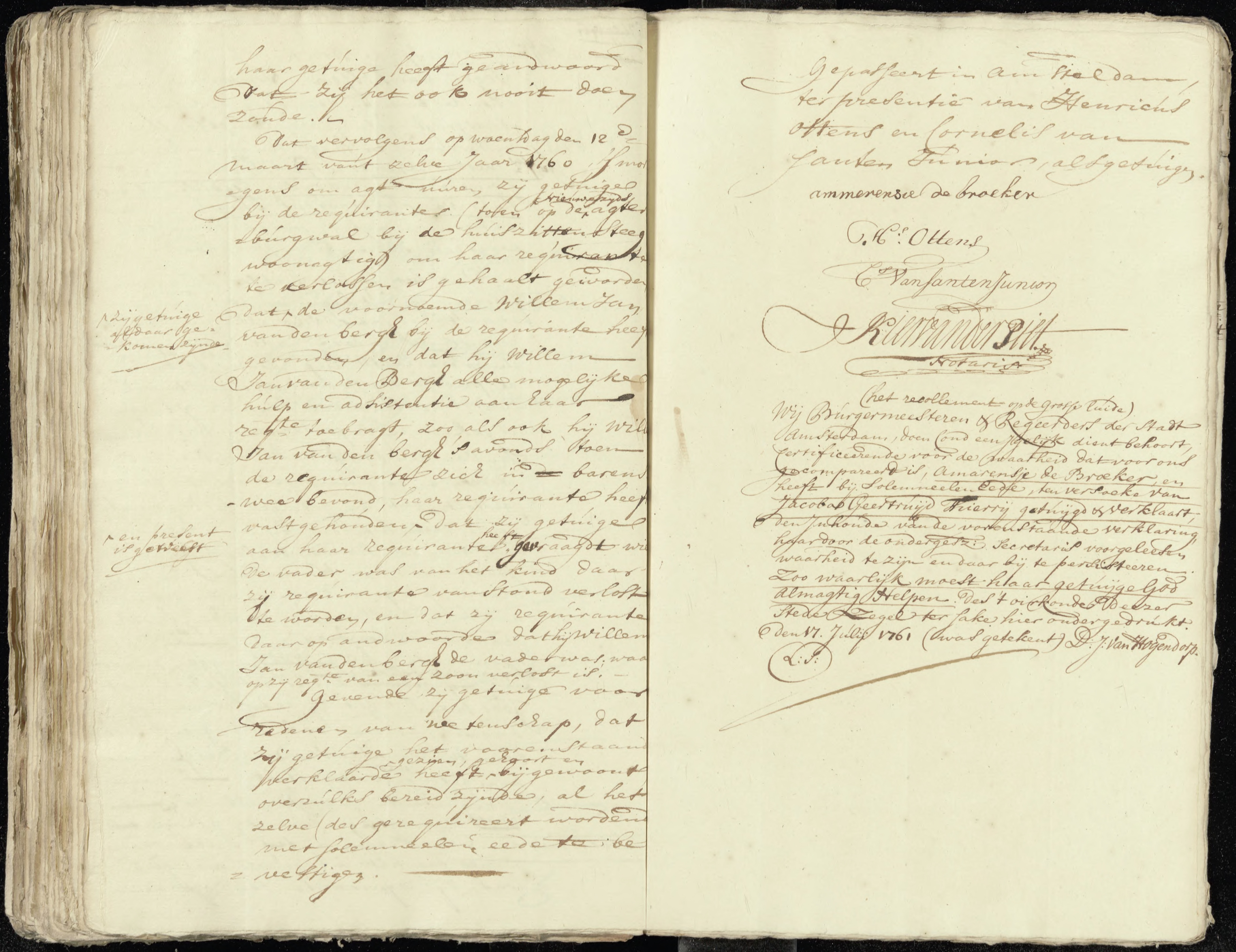
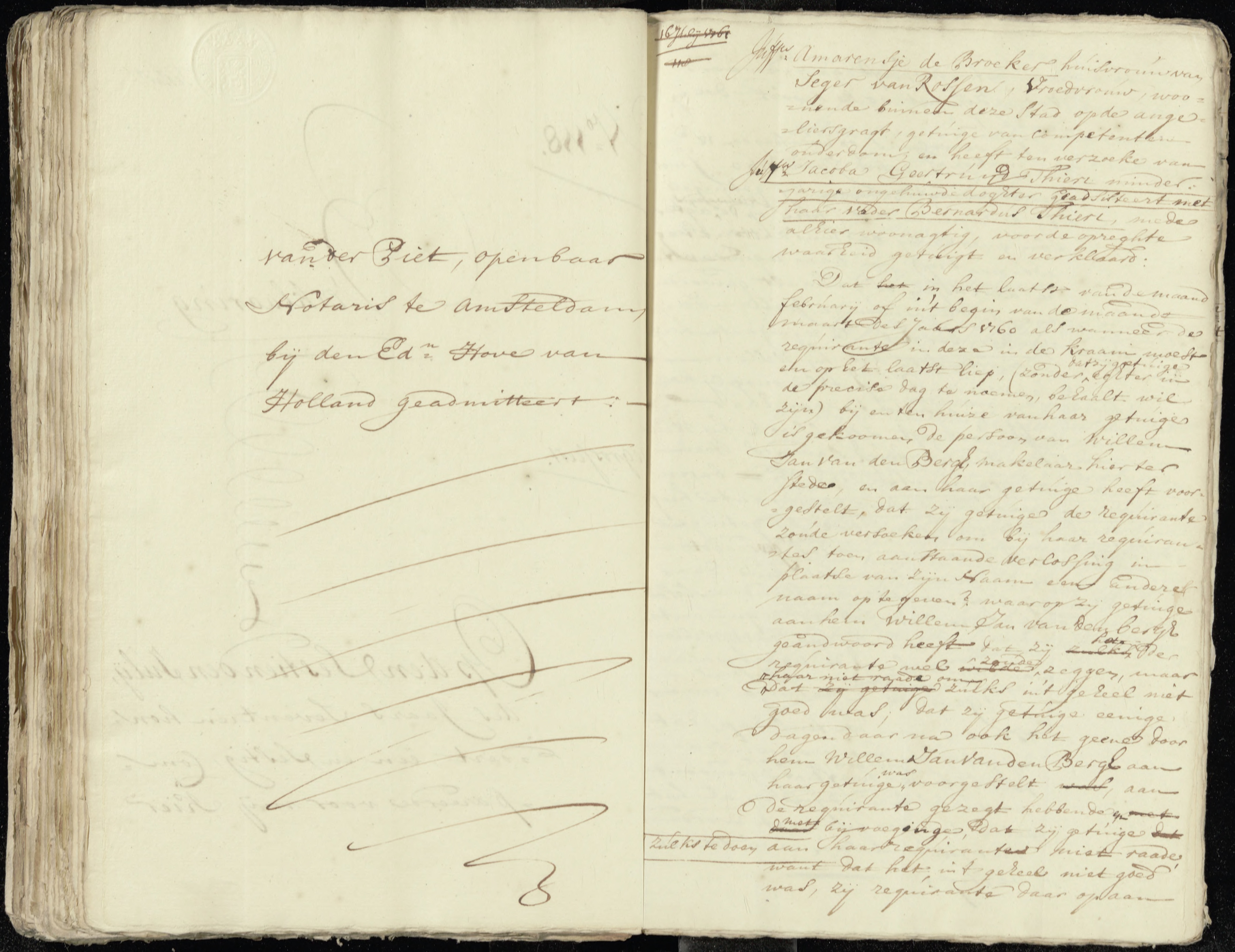
1. Testimony of Midwife Amarensje de Broeker (Amsterdam, July 16, 1761)Notarial Archives Amsterdam, Notary Kier van der Piet (confirmed under oath / recolliment on July 17, 1761):
"On the sixteenth day of July in the year seventeen hundred and sixty-one, appeared before me, Kier van der Piet, public Notary in Amsterdam, Mistress Amarensje de Broeker, wife of Seger van Rossen, Midwife, residing within this City on the Anjeliersgracht, a witness of competent age, who at the request of Miss Jacoba Geertruy Thieri, an unmarried minor daughter, assisted by her father Bernardus Thieri, also residing here, testified and declared for the sincere truth:
That at the end of the month of February or at the beginning of the month of March in the year 1760, when the petitioner herein was due to give birth and was near her term (without the witness wishing to be bound to name the exact day), the person of Willem Jan van den Bergh, broker in this City, came to the house of the witness and proposed to her that she ask the petitioner, at her then impending delivery, to give another name instead of his name; to which the witness answered Willem Jan van den Bergh that she would indeed tell the petitioner, but advised her against it as it was not good at all; that a few days later, the witness having told the petitioner what Willem Jan van den Bergh had proposed to her, adding that she advised the petitioner not to do so because it was not good at all, the petitioner thereupon answered the witness that she would never do so either.
That subsequently, on Wednesday the 12th of March of the same year 1760, at eight o'clock in the morning, the witness was fetched to the petitioner (then residing on the Nieuwezijds Achterburgwal near the Huiszittensteeg) to deliver her; that upon arriving there, the aforementioned Willem Jan van den Bergh rendered all possible help and assistance to her, just as Willem Jan van den Bergh in the evening, when the petitioner was in labor pains, held the petitioner and was present when the witness asked the petitioner who the father was of the child she was about to be delivered of, and that the petitioner thereupon answered that Willem Jan van den Bergh was the father, whereupon she was delivered of a son.
Giving as reasons for her knowledge that she, the witness, saw, heard, and attended all that is declared above, being therefore ready, if required, to confirm the same by solemn oath."
2. Marriage Banns of Susanna Maria Dulken & Willem van Hoesem (Amsterdam, January 14, 1780)
"Appeared as before Willem van Horsen [Hoesem], of Amsterdam, Reformed, aged 42 years, in the Oude Looijersstraat, senior licentiate, and Susanna Maria Dülken, of Amsterdam, Reformed, aged 24 years, on the Reguliersgragt, assisted by her mother Catharina Kooning." (Margin note: "Mother's consent duly submitted")
3. Marriage Banns of Jan Dulken & Margaretha Koers (Amsterdam, April 17, 1795)
"The 17th of April 1795. Appeared as before Jan Dulken, of Hasselt, Reformed, aged 27 years, in the Leidsekruisstraat below the Pawnshop, parents dead, assisted by Dirk Steen, in the Lange Leidsedwarsstraat. Margaretha Koers, of Giethoorn, Reformed, aged 24 years, on the Keizersgracht, parents dead, assisted by Jannetje Fredriks Smienk, on the Brouwersgracht."
4. Surety Deed of Louis Dulken (Paris, August 31, 1795 / 14 Fructidor Year III)
"Continuation of the 14th Fructidor, Year III. Today appeared Louis Dulken, harpsichord maker, residing in Paris at No. 32, rue Martin et du Figuier, who stated that he stands surety for Citizen Dulken, his wife, toward Citizen Bouvet for the sum of five thousand nine hundred and four livres, as set forth in the judgment of the 2nd of the current [month], and has signed: Louis Dulcken."