The Dulcken Project
Throughout the history of the Dulcken family, theology, music, and engineering have formed a central defining thread for centuries.
Genealogical research into this dynasty begins in the sixteenth century with the Wundarzt (surgeon) Eberhard von Dülcken (c. 1535–1617). Following a succession of medical practitioners in the early generations — including the physician Johannes von Dülcken and the rector-surgeon Johannes (Jan) Dülcken — the family's focus gradually shifted toward the disciplines of religion, craftsmanship, and music.
This transition began with the theologian and organist Eberhard Dulcken. His son, Pastor Georg Ludwig Dülcken of Wingeshausen, combined his theological office with deep expertise in organ building. He cast his own organ pipes and served as an external consultant; in October 1724, he and organist Johann Conrad Diehl were called to Heinsberg to inspect and document defects in the local organ. The generational synergy between mechanics and acoustics culminated internationally with his son, Johannes Daniel Dulcken, whose Antwerp-built harpsichords achieved renown far beyond the city borders.
Louis Dulcken Sr.: Innovation and Expansion
Johannes Daniel's son, Louis Dulcken Sr. (Johannes Lodewijk), followed closely in his father's footsteps. From 1755 to 1762, he was active as an instrument maker in Amsterdam. His period of activity ran parallel to that of Hendrik Blötz, who advertised two fortepianos in the Amsterdamsche Courant on 15 July 1758 and also constructed the organ for Curaçao. Louis Sr. subsequently relocated his business to Hasselt (Overijssel). His period in Hasselt was characterized by an itinerant operation serving local inns, but also by a turbulent legal history. The extensive court records from this era offer a wealth of historical data today.
His ambitions to become burgomaster of Hasselt met with fierce opposition from the ruling magistrates. This eventually resulted in his imprisonment when he refused to disclose the names of his political supporters. Alongside this political struggle, he faced charges of sodomy, an offense that carried the death penalty at the time. In 1775, Louis Sr. returned to Antwerp with his son Louis Jr. and several of his craftsmen to revive the family workshop; his wife, Catharina Koning, departed Hasselt in 1776.
Louis Dulcken Jr.: The Path to the European Elite
The return to Antwerp marked the formal introduction of Louis Jr. (Jan Lodewijk) to the trade. While traditional encyclopedias state that he learned the craft in Paris, archival letters found in Utrecht prove that he was already working full-time in his father's Antwerp workshop by the age of 13. During this period, the family distinguished themselves through technical innovation: on July 6, 1775, the Gazette van Gent advertised a fortepiano developed by Louis Sr., featuring a novel mechanism to regulate dynamics (crescendo and diminuendo).
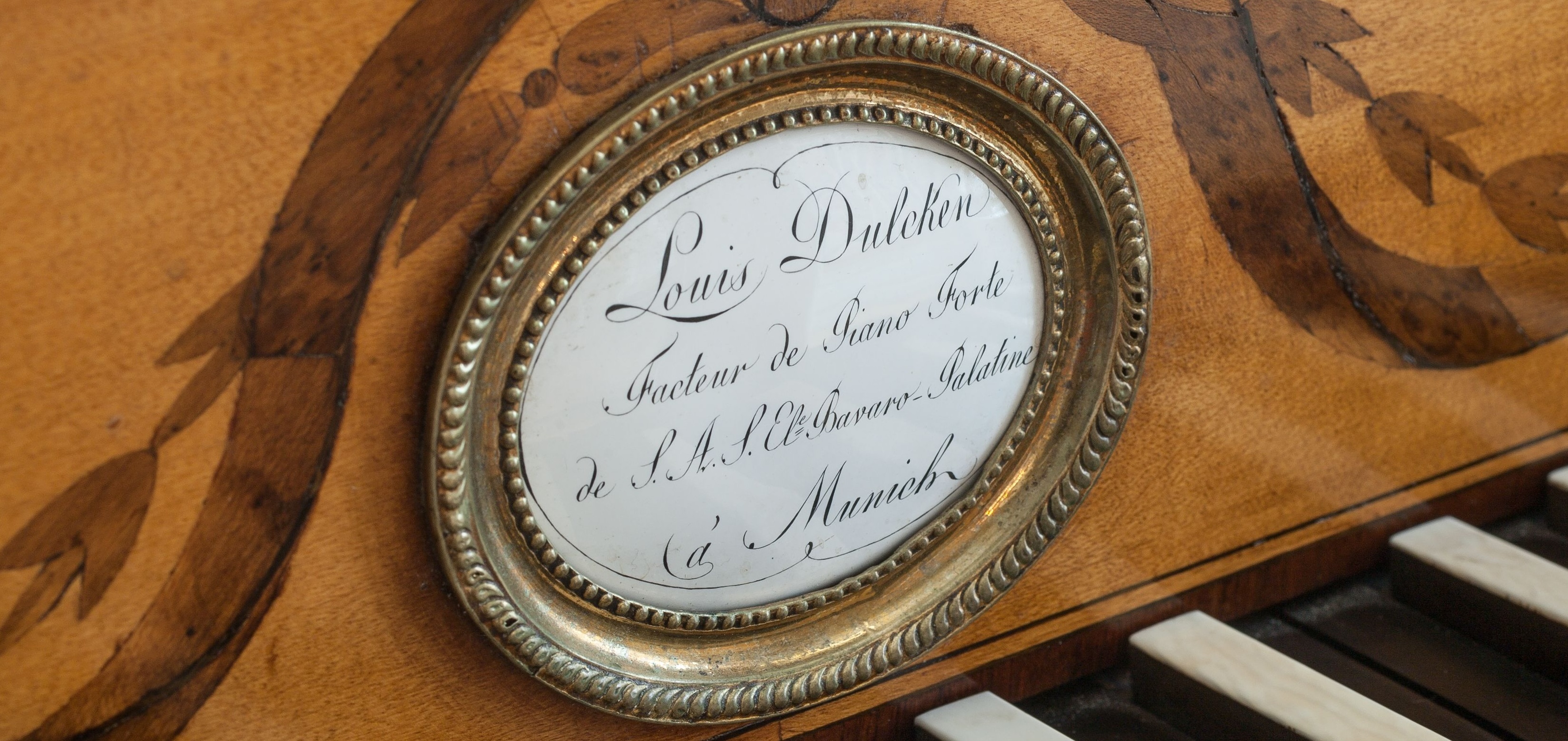
Louis Sr. later established himself as an instrument maker in the Paris of Louis XVI and Marie Antoinette; his son's marriage certificate officially recorded him as "royal instrument maker." Louis Jr. pursued his career in Munich. At the age of 18, he joined the renowned Mannheim Orchestra of Elector Karl Theodor — then the most prestigious musical ensemble in Europe — as an instrument builder.
Traces of Faith
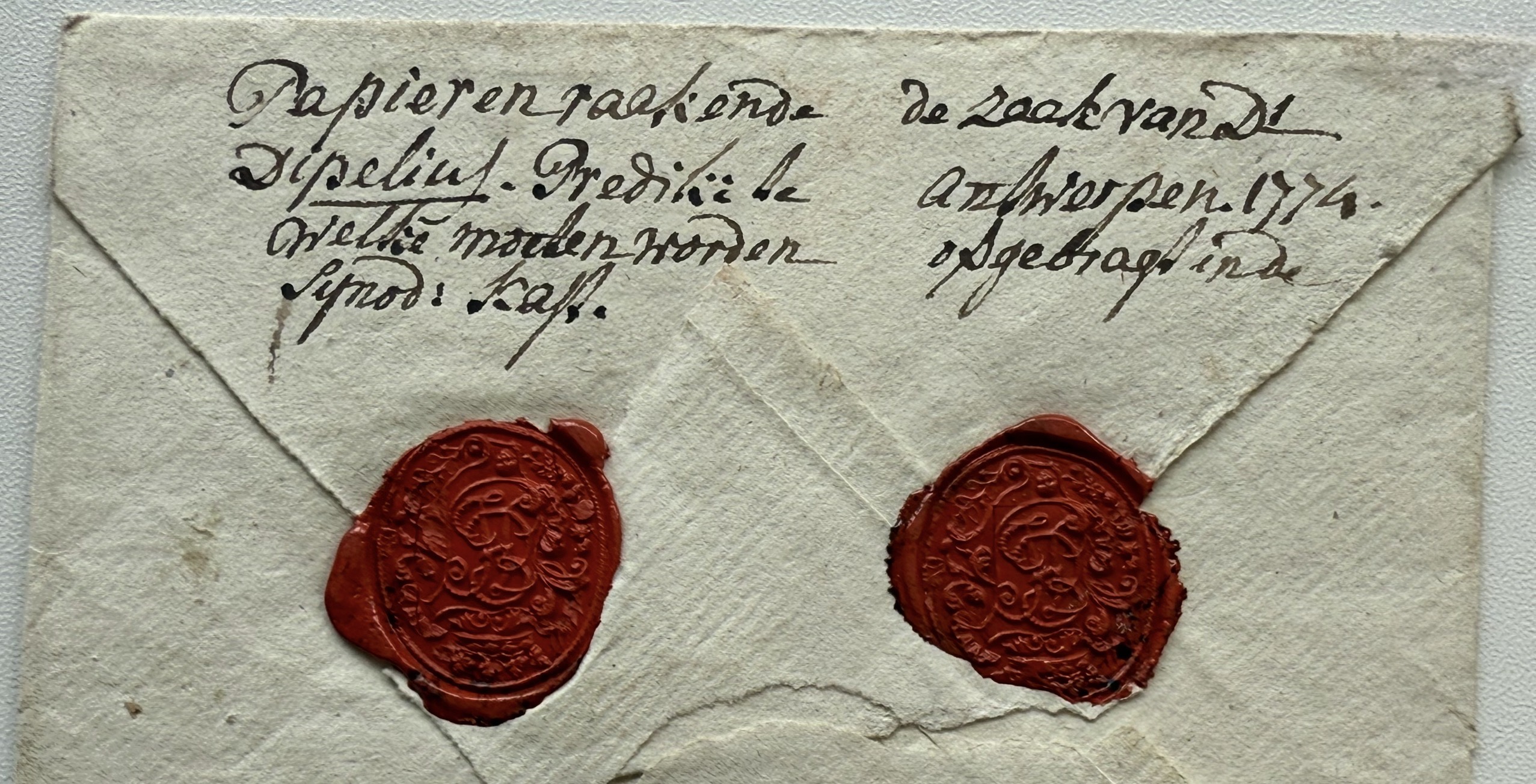
Alongside their craftsmanship, steadfast adherence to the Reformed faith remained a constant factor within the family. Upon returning to Antwerp, the family joined the Olijfbergkerk, the city's sole Reformed congregation. This religious alignment repeatedly brought them into conflict with local orthodoxy. Recently rediscovered correspondence in the Utrecht Archives sheds light for the first time on a protracted scandal involving Pastor Diepelius, who had fathered a child with his niece. Both Johannes Daniel and later Louis Sr. became embroiled in fierce disputes with this minister.
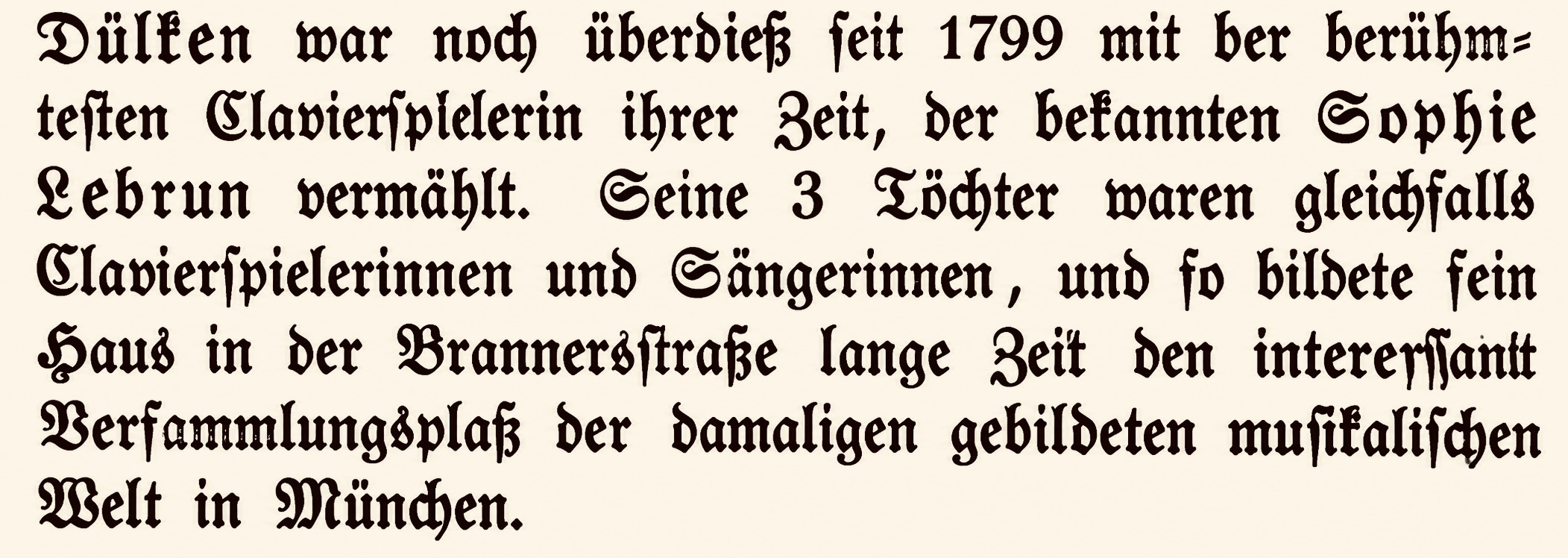
The personal life of Louis Jr. was similarly shaped by religious regulations. He married the celebrated Catholic pianist Sophie Le Brun — the most famous female pianist in Munich. Due to their differing faiths, the couple married twice: first in the Reformed church in Augsburg, and subsequently via a special dispensation during the Catholic Advent season in Munich.
Project Objective
The Dulcken Project brings these diverse historical threads together digitally for the first time. Through original archival documents, rediscovered correspondence, detailed family trees, and surviving instruments, the project illuminates the cultural and historical impact of this unique dynasty of builders and thinkers.
The Dulcken research was made possible by Henk Poelarends of Hasselt (Overijssel), thanks to his knowledge of the old Hasselt archive, and by Hans Meijer, a descendant of the Dulckens. The genealogical research, above all by Ivo de Bruin, led us to the various places where the Dulckens lived and worked.
In addition, we thank all the archives and the people who scanned archival documents and helped us along the way. They are credited by name beneath each scan published on our website.
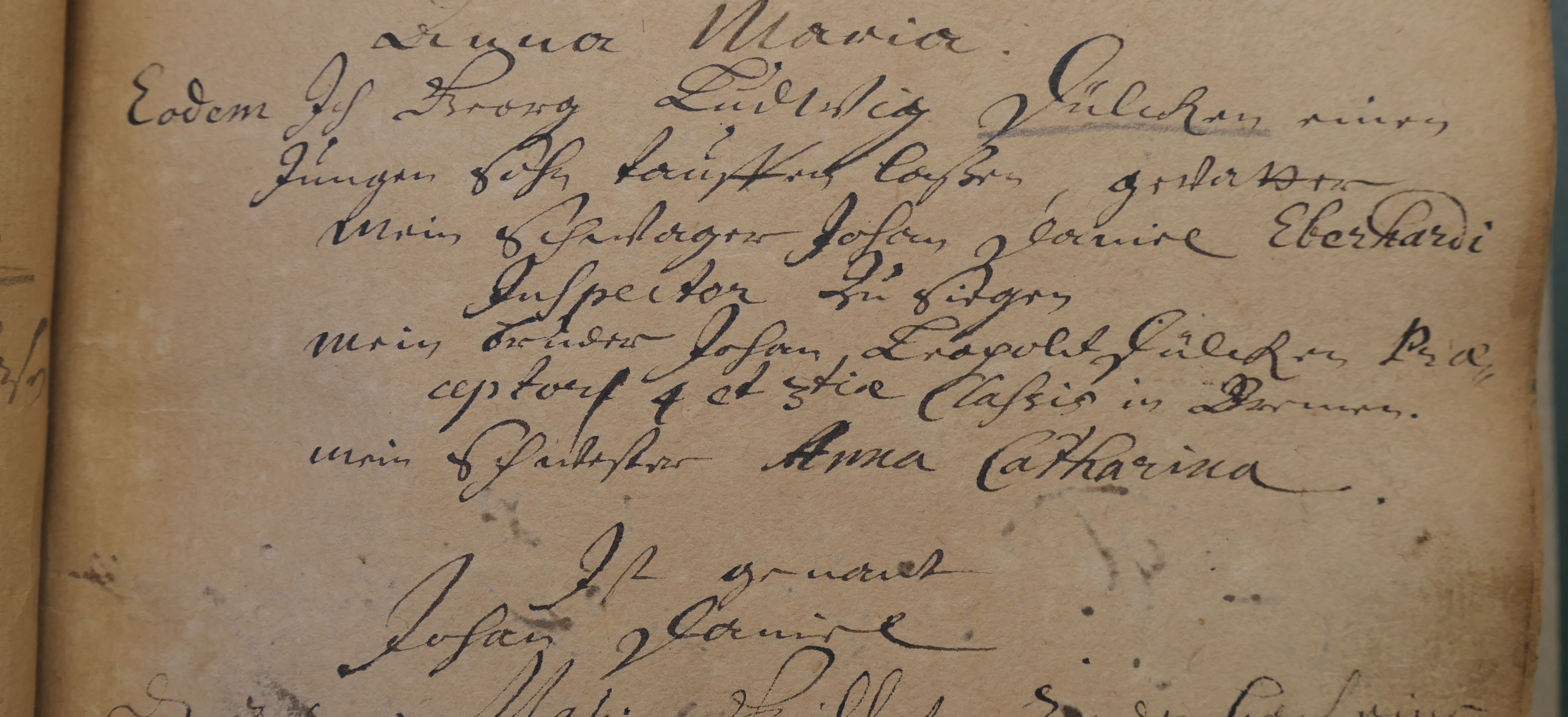
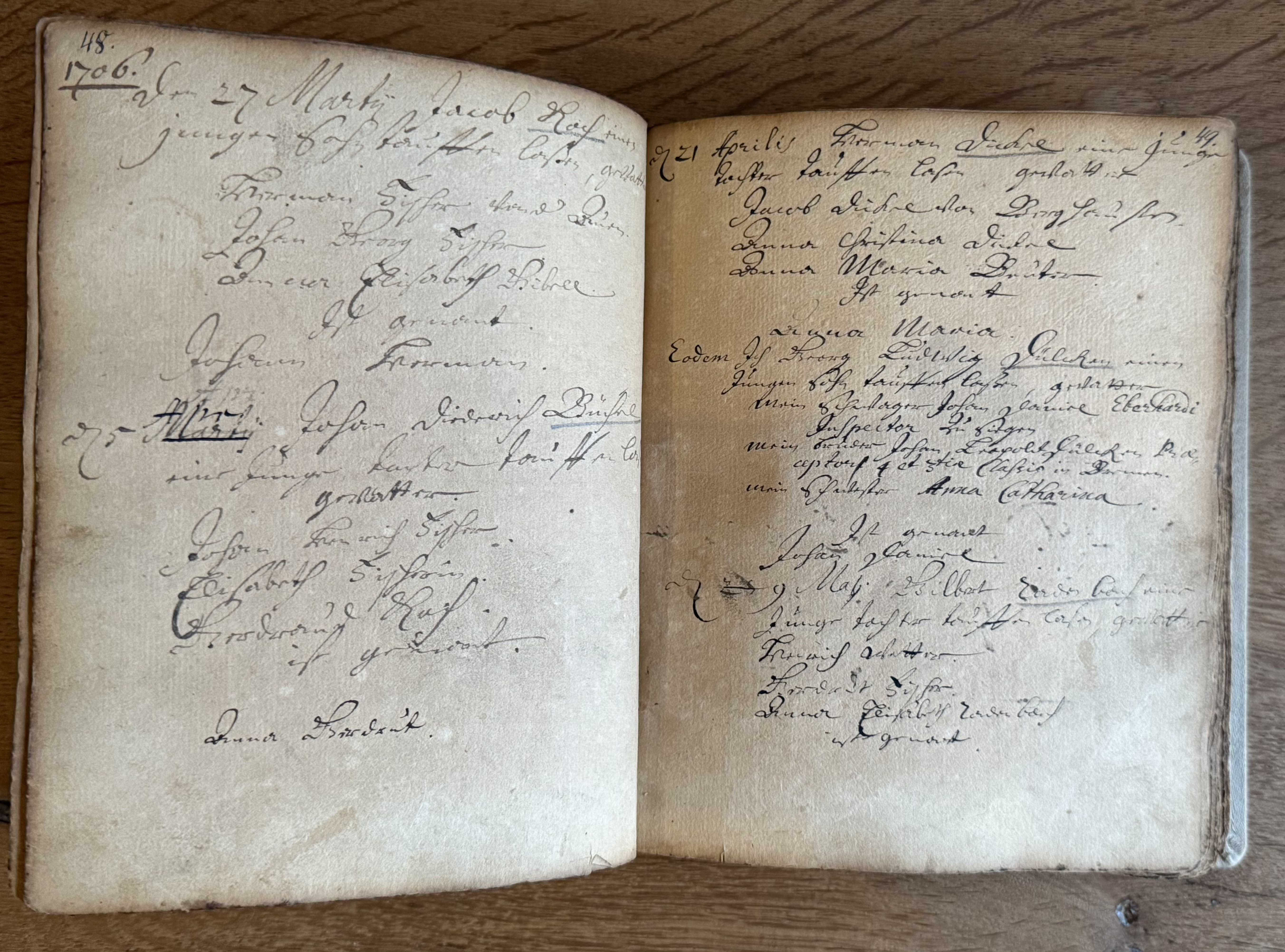
Eodem Ich Georg Ludwig Dülcken einen
Jungen sohn tauffen laßen, gevatter:
mein Schwager Johan Daniel Eberhardi
Inspector zu Siegen
mein Bruder Johan Leopold Dülcken,Prae=
ceptore 4 et 3 ter Classis in Bremen
mein schwester Anna Catharina.
Ist genant
Johan[n] Daniel.
🇬🇧
On the same day [Eodem], I, Georg Ludwig Dülcken, had a young son baptized.
Godparents / Sponsors:
My brother-in-law Johan Daniel Eberhardi, Inspector in Siegen
My brother Johan Leopold Dülcken, teacher [Praeceptor] of the 4th and 3rd class in Bremen
My sister Anna Catharina. Named: Johan[n] Daniel.
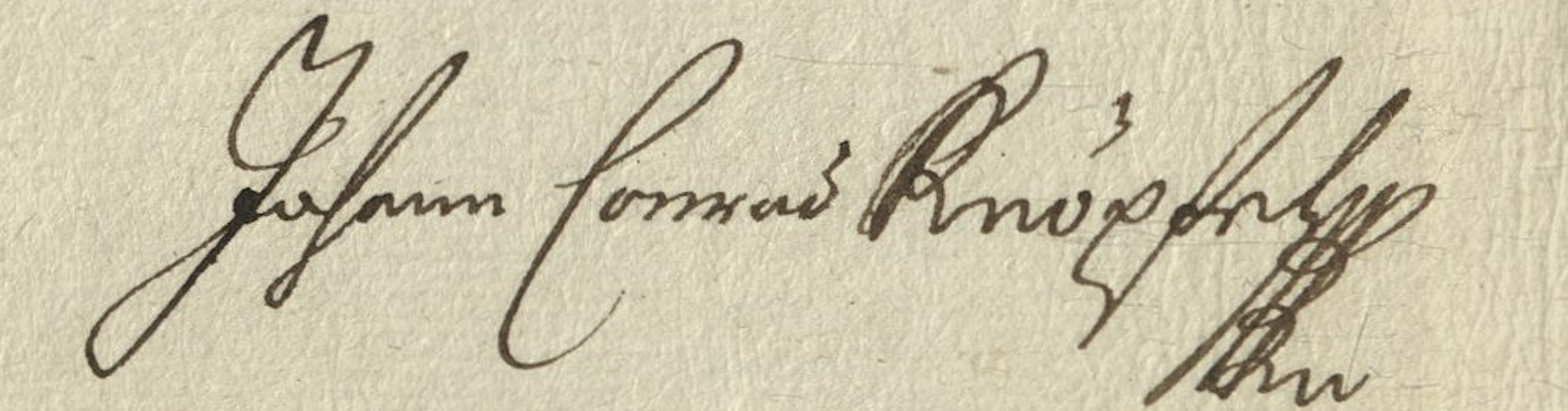
🇬🇧 Johann Conrad Knöpfel - Sankt Goar/Burg Rheinfels
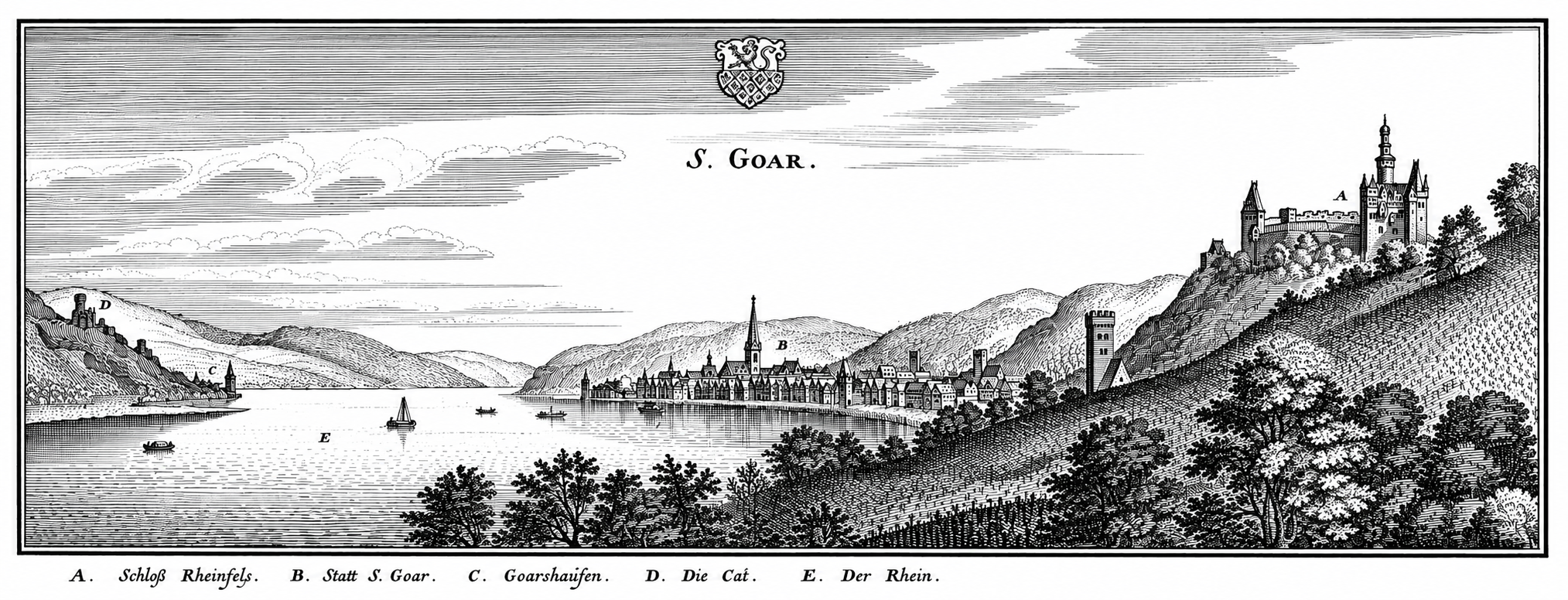
Mr. Johann Conrad Knöpffel, Commissar of Supplies and Collegiate Monastery Cellarer here
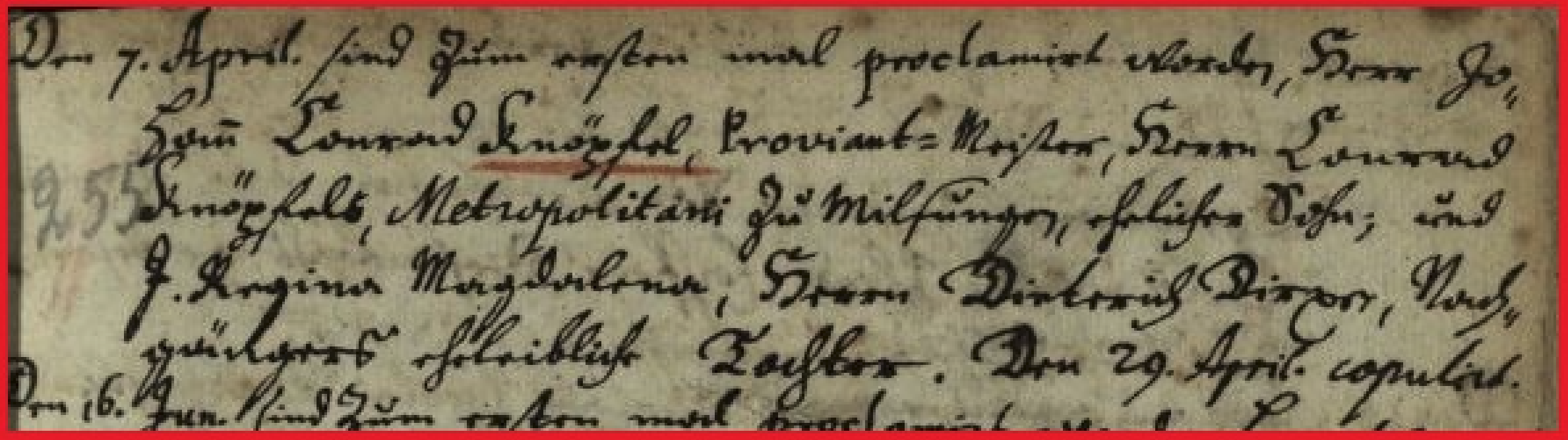
Conrad Knöpfel, born in Wolfershausen in 1662, enrolled at the University of Marburg in 1680, became quartermaster at the Hessian fortress of Rheinfels near St. Goar. Conrad Knöpfel married Regina Magdalena Dirx on 29 April 1695. Conrad Knöpfel died before 1721
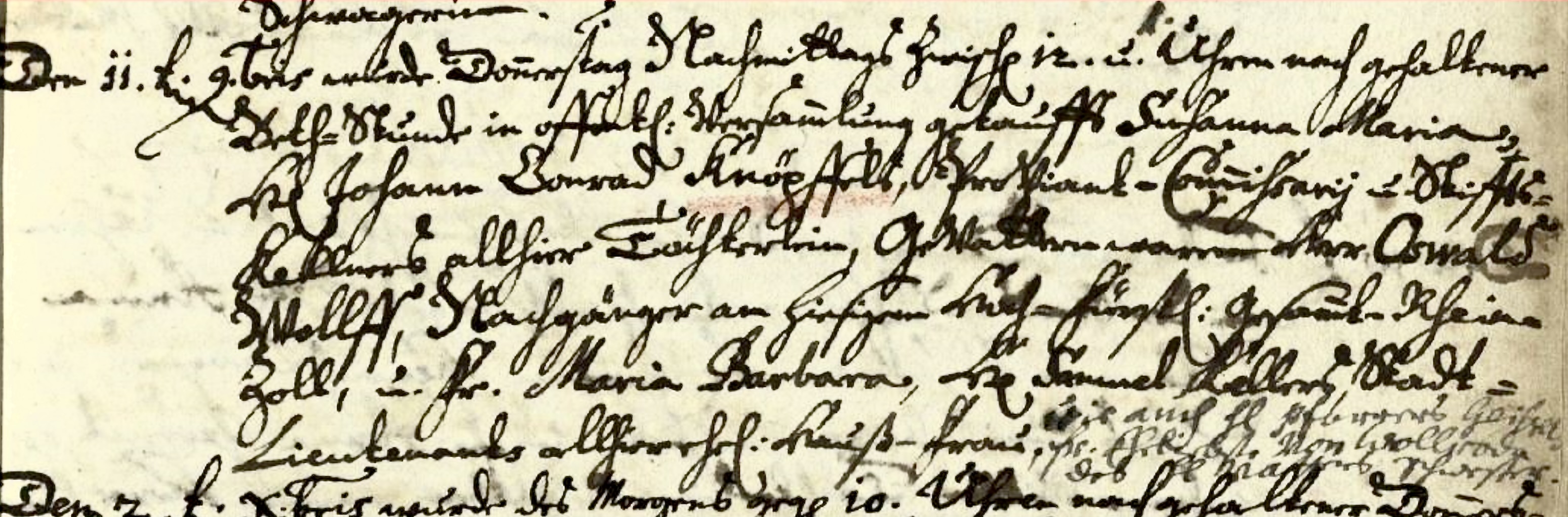
Baptism record of Susanna Maria Knöpfel - transcriptie Dr. Johannes Burkardt
Baptism of Susanna Maria Knöpffel, daughter of Johann Conrad Knöpffel, Proviant-Commissair en Stift-Kellner at St Goar, on 11 September 1706 (Archiv der Evangelischen Kirche im Rheinland, Boppard, KB 149/1 (St. Goar ref.), p. 149.)
Den 11 t[en] [Novem]bris wurde Don[n]erstag Nachmittags zwisch[en] 12 u[nd] 1 Uhren
nach gehaltener
Beth=Stunde in öffentl[icher] Versam[m]lung getaufft Susanna Maria,
H[errn] Johann Conrad Knöpffels, Proviant-Com[m]issarii u[nd] Stiffts=
Kellners allhier Töchterlein. Gevattern waren Herr Oswald
Wollff, Nachgänger am hiesigen Hoch=Fürstl[ichen] Gesam[m]t-Rhein=
Zoll, u[nd] Fr[au] Maria Barbara, H[errn] Samuel Kellers, Stadt=
Lieutenants allhier ehel[iche] Hauß-Frau, wie auch H[errn] Pfarrers Geissel
Fr[au] Eheliebste von Wollroda
des H[errn] Vatters Schwester.* * Die letzten 12 Wörter mit blasserer Tinte später nachgetragen.

Marriage record for Johann Daniel Dülcken and Susanna Maria Knüpfelin, 1733
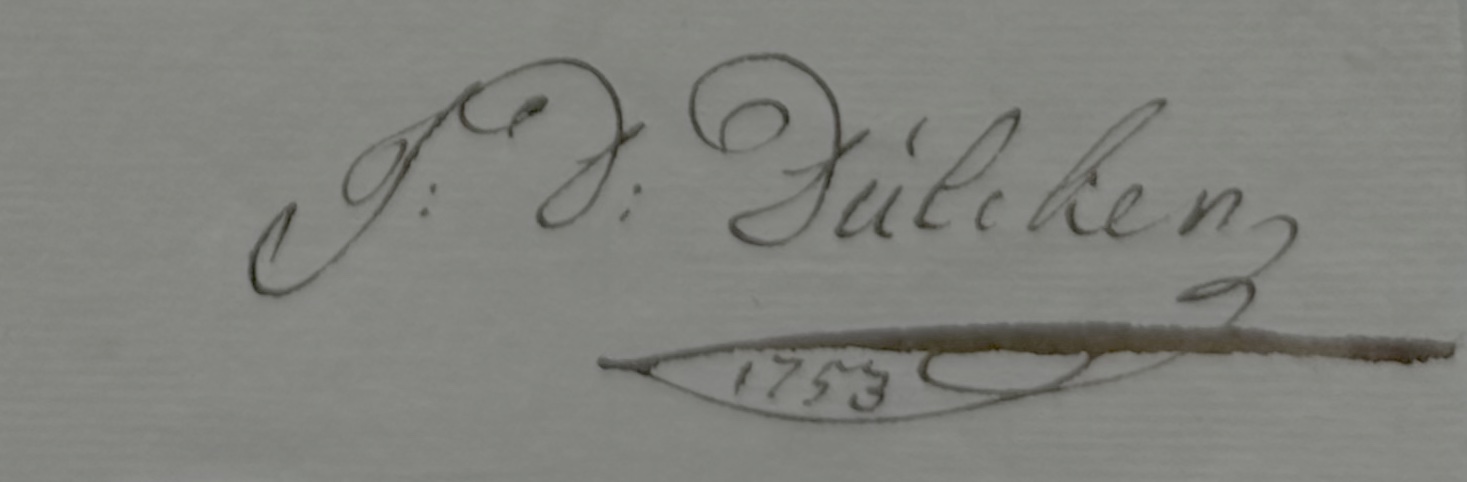
(Wingeshausen 21 april 1706 – † Antwerpen 11 april 1757 - buried in Putte
(Sankt Goar 11 september 1706 - † Heerde 12 juni 1789)
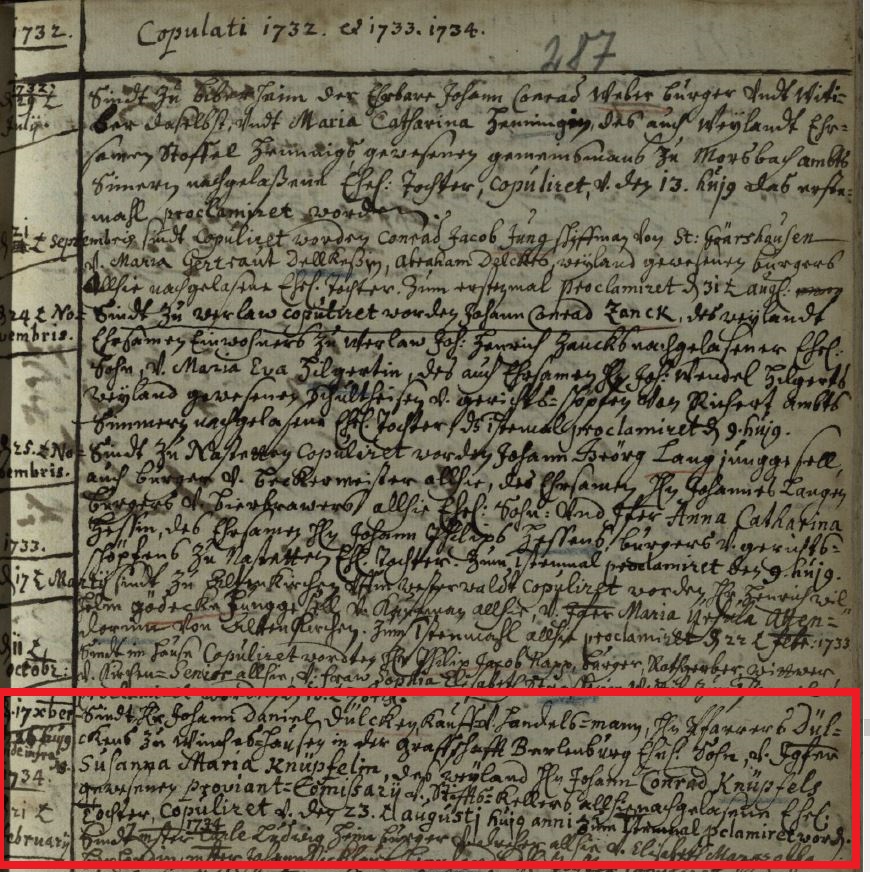
Heiratseintrag Johann Daniel Dülcken und Susanna Maria Knüpfelin - transcriptie Dr. Johannes Burkardt
17. [Decem]ber * Sindt H[er]r Johann Daniel Dülcken, Kauff- u[nd] Handels=mann, H[errn] Pfarrers Dül= ckens zu Winches=hausen (sic!) in der Graffschafft Berlenburg Ehel[icher] Sohn, u[nd] J[ung]fer Susanna Maria Knüpfelin, des weyland H[errn] Johann Conrad Knüpfels gewesenen proviant=Com[m]issarii u[nd] Stiffts=Kellers allhie, nachgelasene Ehel[iche] Tochter, copuliret u[nd] den 23 t[en] augusti hui[us] anni zum I stenmal p[ro]clamiret word[en]. * Darunter Eintrag mit blasserer Tinte, aber von gleicher Hand: „16. hui[us] de infra. N[ota] B[ene].“
Marriage of the merchant and trader Johann Daniel Dülcken, son of Pastor Dülcken at Wingeshausen in the County of Berleburg, to Susanna Maria Knüpfelin, daughter of the late Provisions Commissioner and Collegiate Receiver Johann Conrad Knüpfel, on 17 December 1733
(For the 1733 marriage entry: Archive of the Evangelical Church in the Rhineland, Boppard, KB 149/1 (St. Goar ref.), p. 287.)
17 [Decem]ber – The Master Johann Daniel Dülcken, merchant and trader, legitimate son of Pastor Dülcken at Wincheshausen (sic! [meaning Wingeshausen]) in the County of Berleburg, and Maiden Susanna Maria Knüpfelin, legitimate surviving daughter of the late Master Johann Conrad Knüpfel, in life Provisions Commissioner [for the Rheinfels Fortress] and Collegiate Receiver (Stiftskellner) here, joined in holy matrimony, after their banns were published for the 1st time on 23 August of this year. (Underneath an entry in paler ink, but in the same hand: "16th of this [month] from below. N.B.")
Stifts-Keller (Collegiate Receiver / Steward): The chief financial officer and steward (Rentmeister) of the collegiate church/monastery, responsible for financial management, the collection of rents, and the administration of properties.
Proviant-Commissarii (Provisions Commissioner): The logistics officer responsible for supply management and provisioning (such as grain, food, and equipment) for the strategic Imperial Fortress of Rheinfels in Sankt Goar.
Historical context point: The term "allhie" (here/in this place) confirms the location of the marriage in Sankt Goar, right at the foot of Rheinfels Fortress and the seat of the St. Goar collegiate church (stift).
🇬🇧 A hasty Advent wedding: The marriage of Johann Daniel Dülcken and Susanna Maria Knüpfel in the Stiftskirche of St. Goar, beneath the shadow of Burg Rheinfels In the strategically vital garrison town of St. Goar, Susanna Maria Knüpfel grew up within the absolute upper echelon of the early modern administrative elite. Her father, Johann Conrad Knüpfel, held an influential dual position that bridged the military and ecclesiastical powers of the County of Hesse. As proviant-commissarius, he directed the logistics of the mighty fortress of Burg Rheinfels, while as Stiffts-Keller (monastic bailiff), he served as the judicial and executive linchpin for the fiscal and civil administration of the local collegiate chapter. This biography illuminates the privileged world of a young woman living at the intersection of law, economics, and the dynamic Rhine trade.
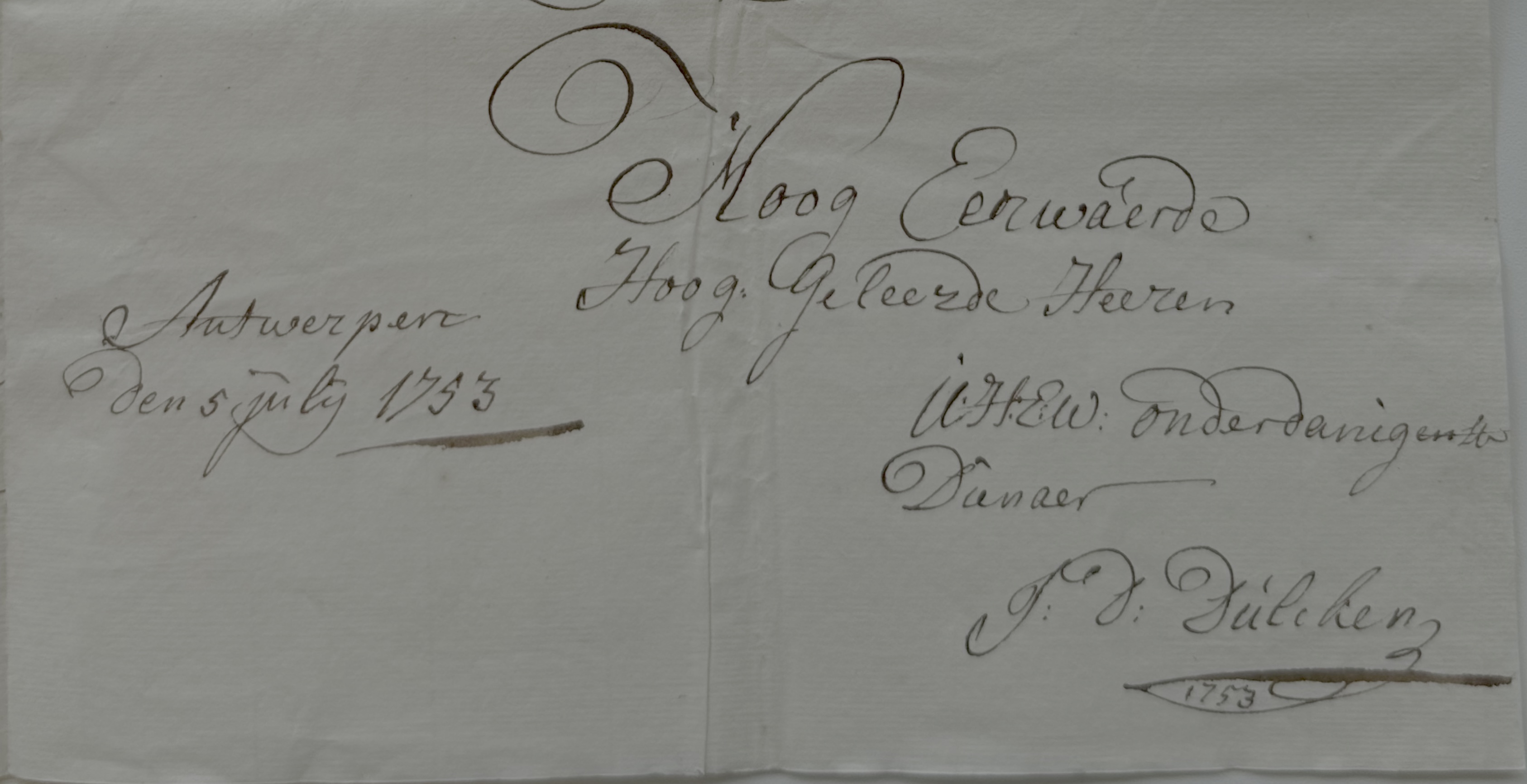
🇳🇱 : Bestemd voor de Synodale Kast: Het vergeten dossier van Ds. Dipelius: Van Haiger tot Antwerpen
🇬🇧 : Intended for the Synodal Archive:
The Forgotten Dossier of Rev. Dipelius: From Haiger to Antwerp
🇩🇪 : Für das Synodalarchiv bestimmt:
Die vergessene Akte des Pfarrers Dipelius: Von Haiger nach Antwerpen
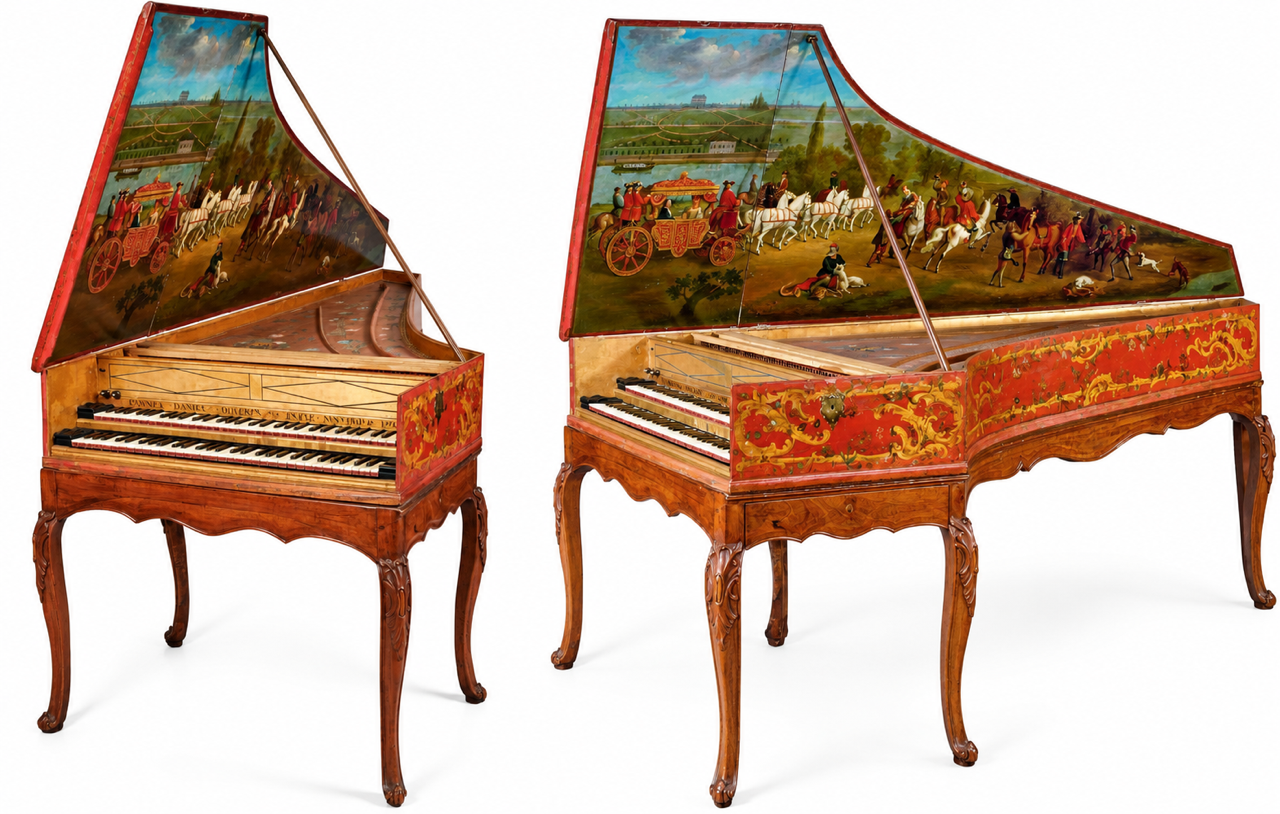
Joannes Daniel Dulcken 1745 - Kunsthistorisches Museum Wien, Sammlung alter Musikinstrumente, 726
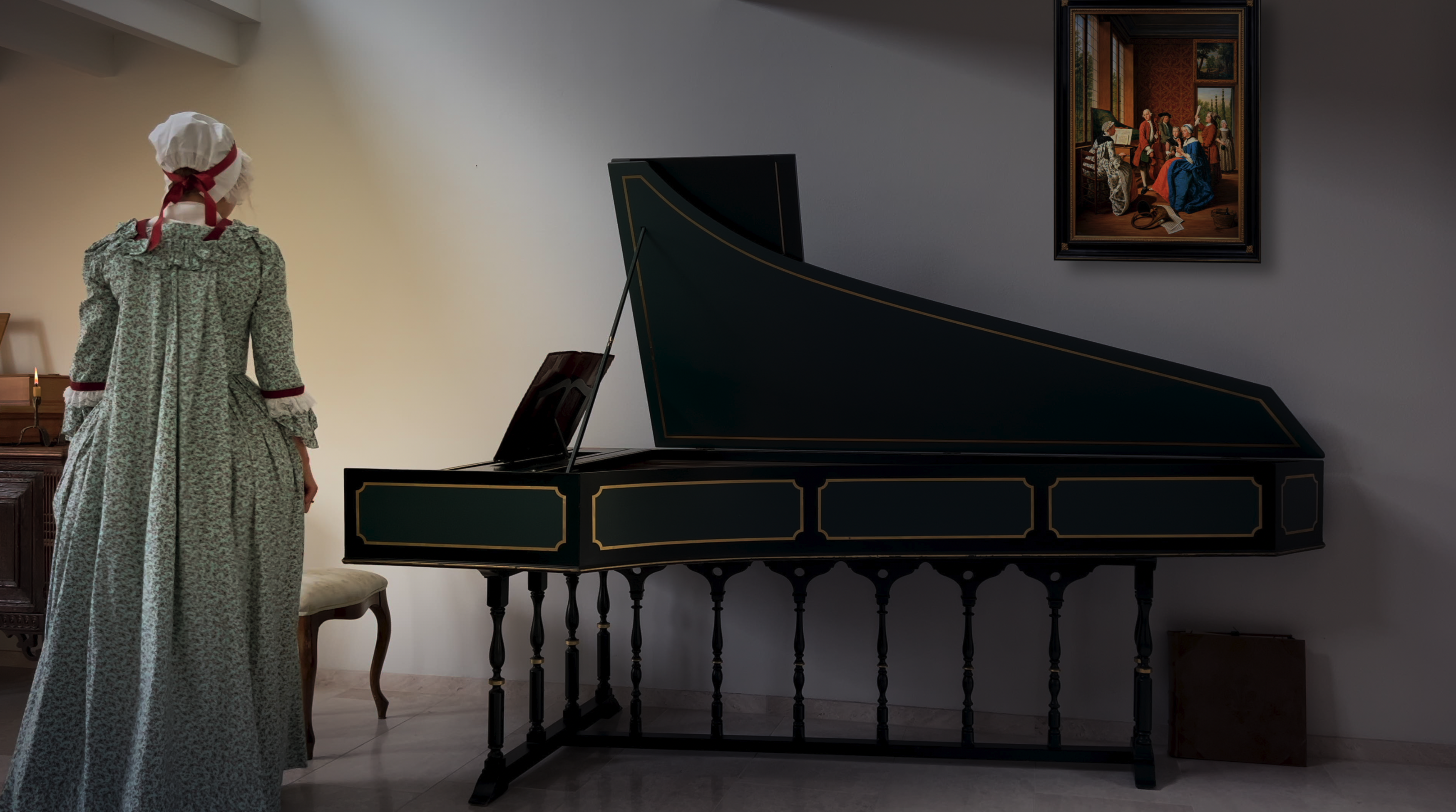
Click on the photo above to play the video
Click on the video above to learn about Susanne Maria Knöpffel, who relocated the Dulcken workshop to Brussels in 1764 following the death of Johannes Daniel Dulcken.
Harpsichords and Harlequins: Commedia dell’arte and the Migration of the Dulcken Family (1764)
Klavecimbelbouw en Komedie: De Commedia dell’arte en de Migratie van de Familie Dulcken (1764)
Van Antwerpen naar Beieren: De verrassende band tussen de families Dulcken en Horemans
From Antwerp to Bavaria: The Surprising Bond Between the Dulcken and Horemans Families
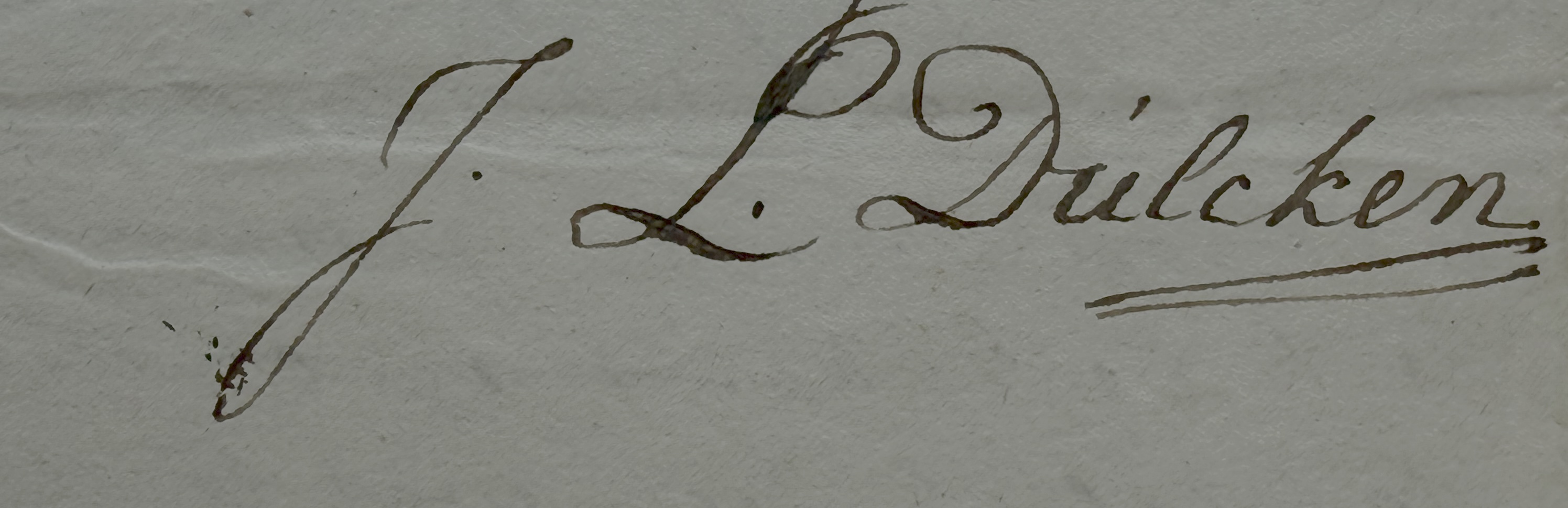

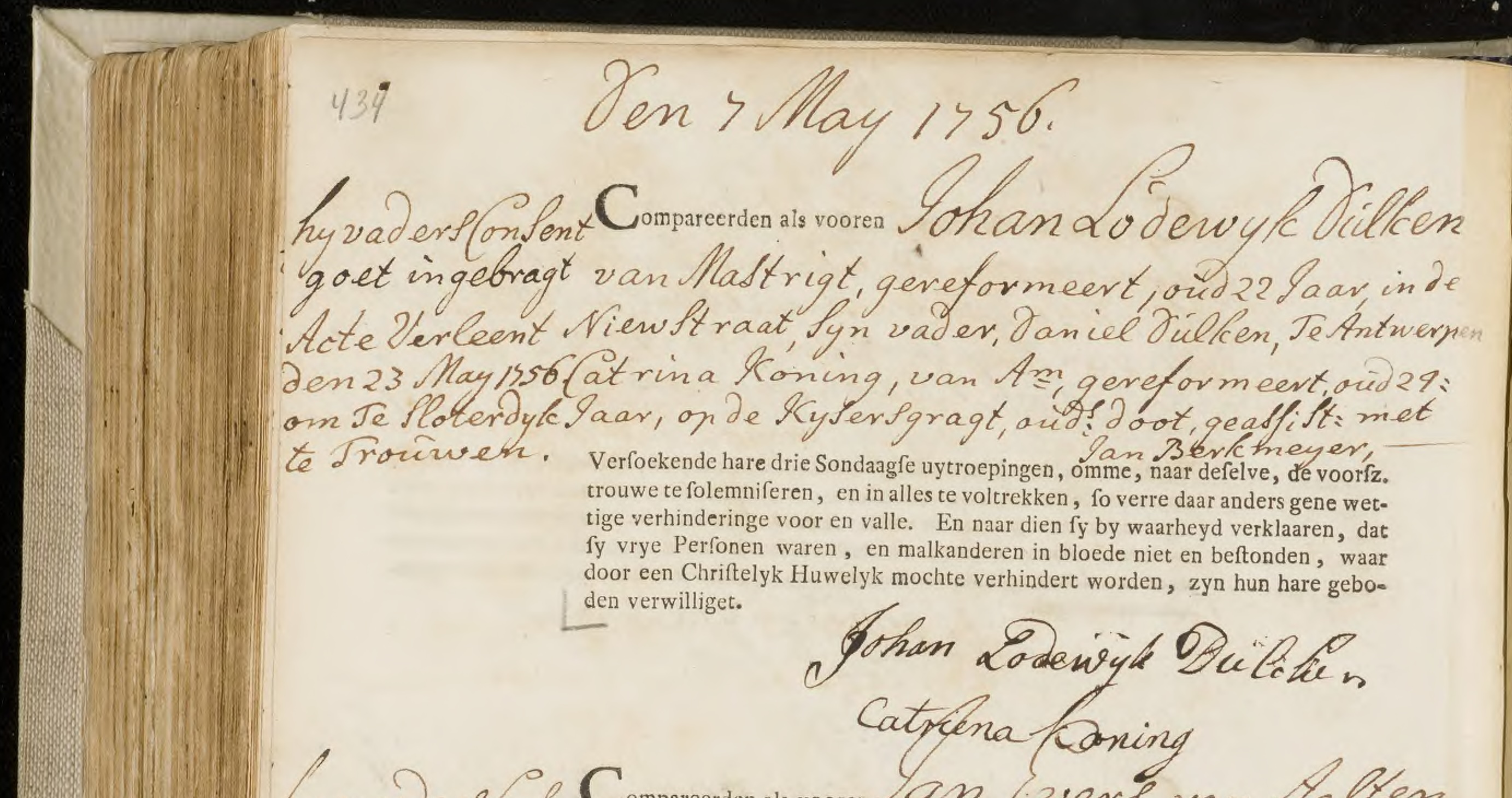
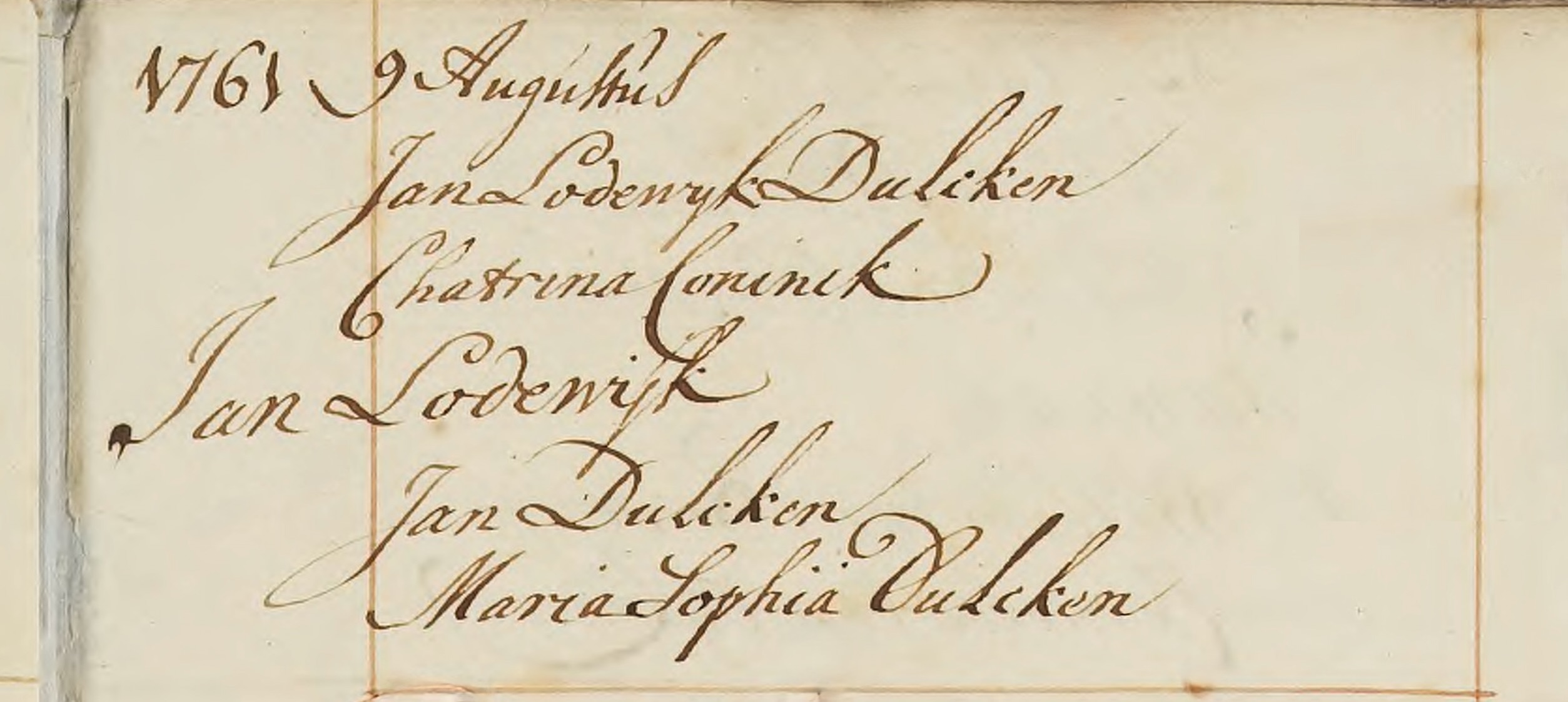
Johannes Lodewijk (Louis)Dülcken
(Maastricht 15 april 1735 – † between August 31, 1795 and December 27, 1799)
Catrina Kooningh (Amsterdam 23 januari 1732- † ?)
Anna ?
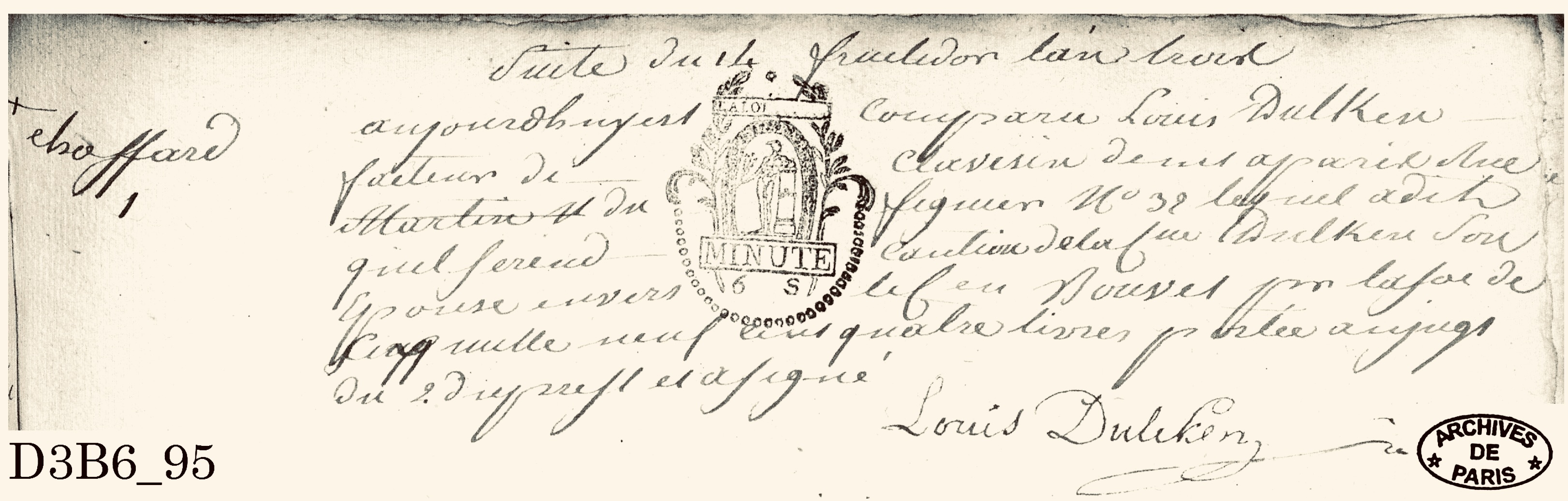
Suite du 14 fructidor l’an trois aujourd'hui est comparu Louis Dulken facteur de clavesin [demt = demeurant?] rue Martin et du figuier N°32 lequel a dit qu'il [se rend] caution de la [citoyenne] Dulken son épouse envers le [citoyen] Bouvet [pour la somme] de cinq mille neuf cens quatre livres portée [au jugement?] du 2 [du présent?] et a signé Louis Dulcken
Continuation of 14 Fructidor, Year III. Today, Louis Dulken, harpsichord maker, residing at No. 32, Rue Martin et du Figuier, appeared and declared that he stands as guarantor for Citizen Dulken—his spouse—to Citizen Bouvet for the sum of five thousand nine hundred and four livres, as stipulated in the judgment of the 2nd of the current [month]; he has signed: Louis Dulken. Transcription by Richard Etiévant.
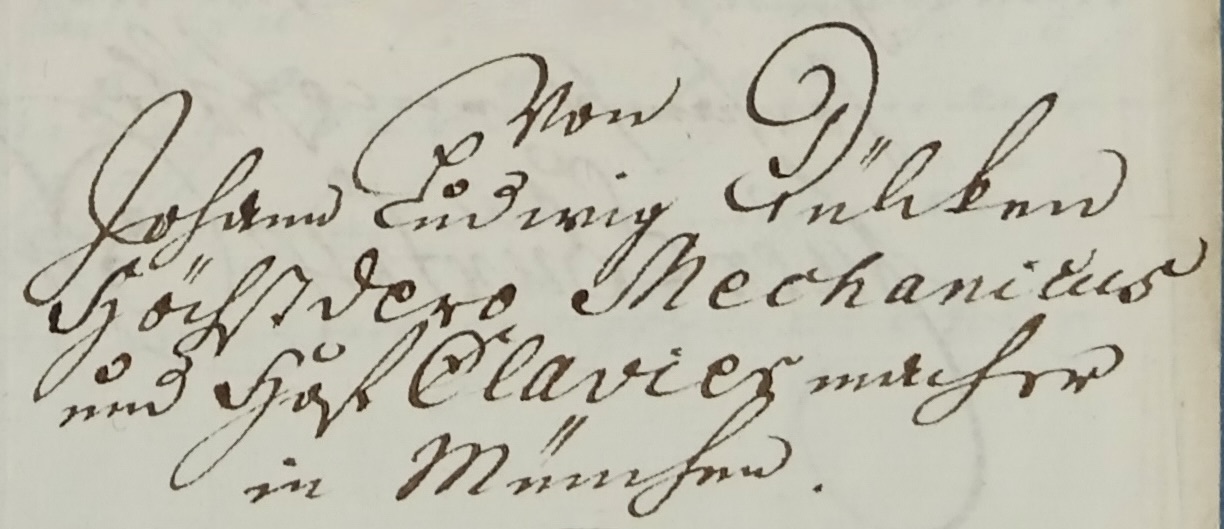
(Amsterdam 9 augustus 1761 – † München 1836)
(London 20 Juli 1781 – † München 23 Juli 1863)
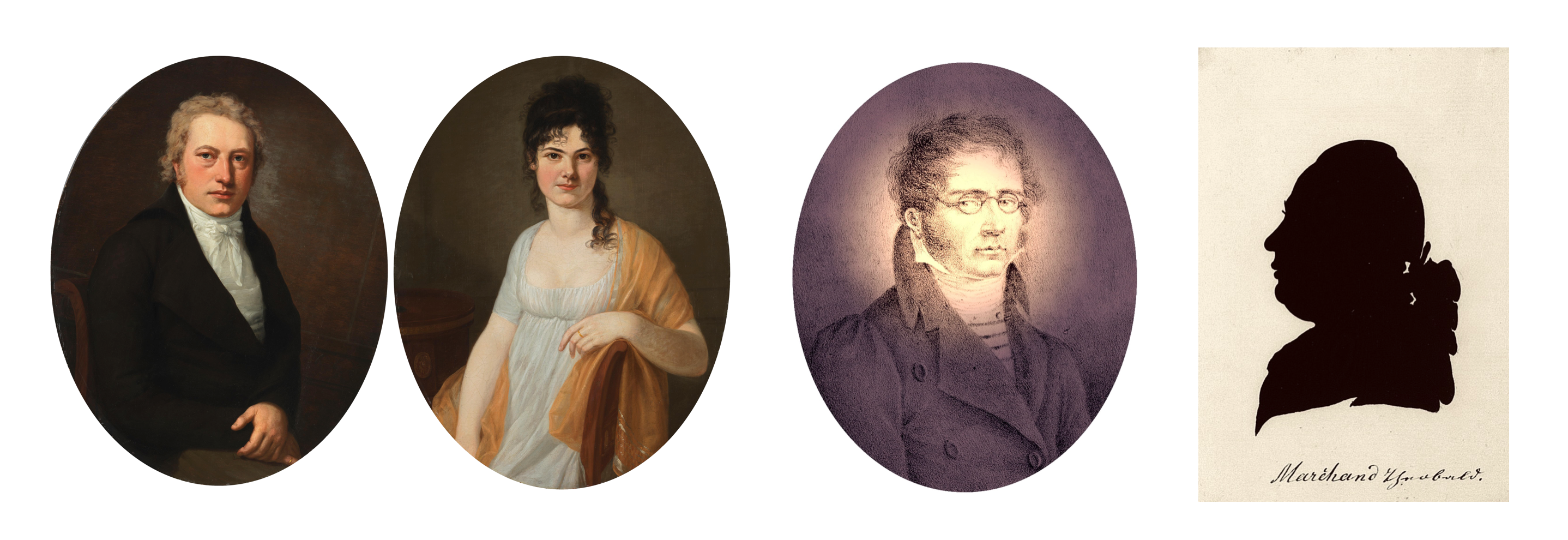
The Mozarts on the Musical Dynasty of Danzi, Lebrun, and Dulcken
The letters of Leopold and Wolfgang Amadeus Mozart are a treasure trove of information about the leading musicians of their time. In their correspondence, the renowned soprano Francesca Danzi and oboist Ludwig August Lebrun play a prominent role, alongside their close-knit musical family: Francesca’s brother, the composer and cellist Franz Danzi, and his wife, the celebrated singer Maria Margarethe Marchand. Their shared musical legacy lived on through Francesca’s daughter Sophia—an exceptionally talented pianist and singer—who later married Louis Dulcken. Read here what father and son Mozart wrote about the performances and artistry of this remarkable family.
Concerto pour le Piano-Forte avec Accompagnement de 2 Violons, Alto, Basso, 2 Flutes, 2 Hautbois et 2 Cors, composé et dédié à Madame Sophie Dulcken née Lebrun par son Oncle Franz Danzi. Oeuvre 4
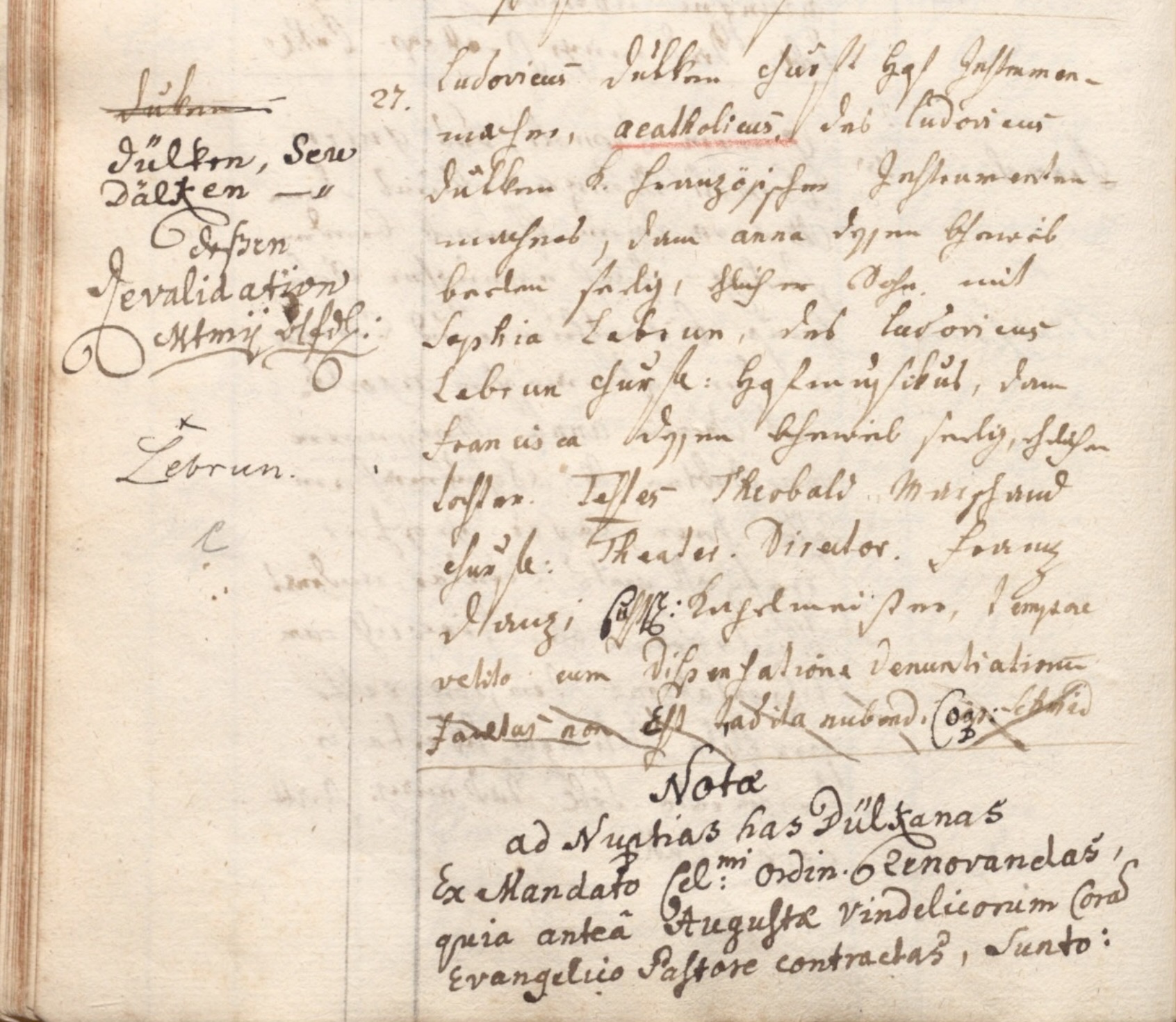
"Nomina Sponsoru[m] Dülken, seu Dälken dessen Revalidation m[a]t[ri]m[on]ii ____ x Lebrun
Dies Mensis 27. Decembris An[n]o 1799
Ludovicus Dülken churf[ürstlicher] Hof-Instrumen[ten]macher, acatholicus, des Ludovicus Dülken k[öniglich] französischen Instrumenten machers, dann Anna dessen Eheweib beiden seelig, ehlicher Sohn, mit Sophia Lebrun, des Ludovicus Lebrun churf[ürstlichen] Hofmusikus, dann Francisca dessen Eheweib seelig, ehelichen Tochter. Testes: Theobald Marchand churf[ürstlicher] Theater-Director, Franz Danzi c[h]u[r]f[ürs]t[licher] Kapelmeister, tempore vetito cum dispensatione denuntiationu[m]”.
Heading: Nomination of the sponsor[s] / Witnesses for Dülken, or rather the validation of their marriage ____ x Lebrun. Day of the month: 27 December in the year 1799.
Body Text: Ludwig Dülken, Electoral Court Instrument Maker, non-Catholic (acatholicus), lawful son of the late Ludwig Dülken, Royal French Instrument Maker, and his late wife Anna, both deceased, with Sophia Lebrun, lawful daughter of Ludwig Lebrun, Electoral Court Musician, and his late wife Francisca, both deceased.
Witnesses: Theobald Marchand, Electoral Theater Director; Franz Danzi, Electoral Kapellmeister.
Ending note: Married during the forbidden time (tempore vetito) with a dispensation for the banns (cum dispensatione denuntiationum).
1800 - Theobald Ludovicus
1801 - Philippus Henricus
1803 - Louise
1805 - Franzisca Magdalena
1807 - Violanda Dulcken
1808 - Juliana Johanna
1813 - Alexander
1817 - Carolina Charlotte
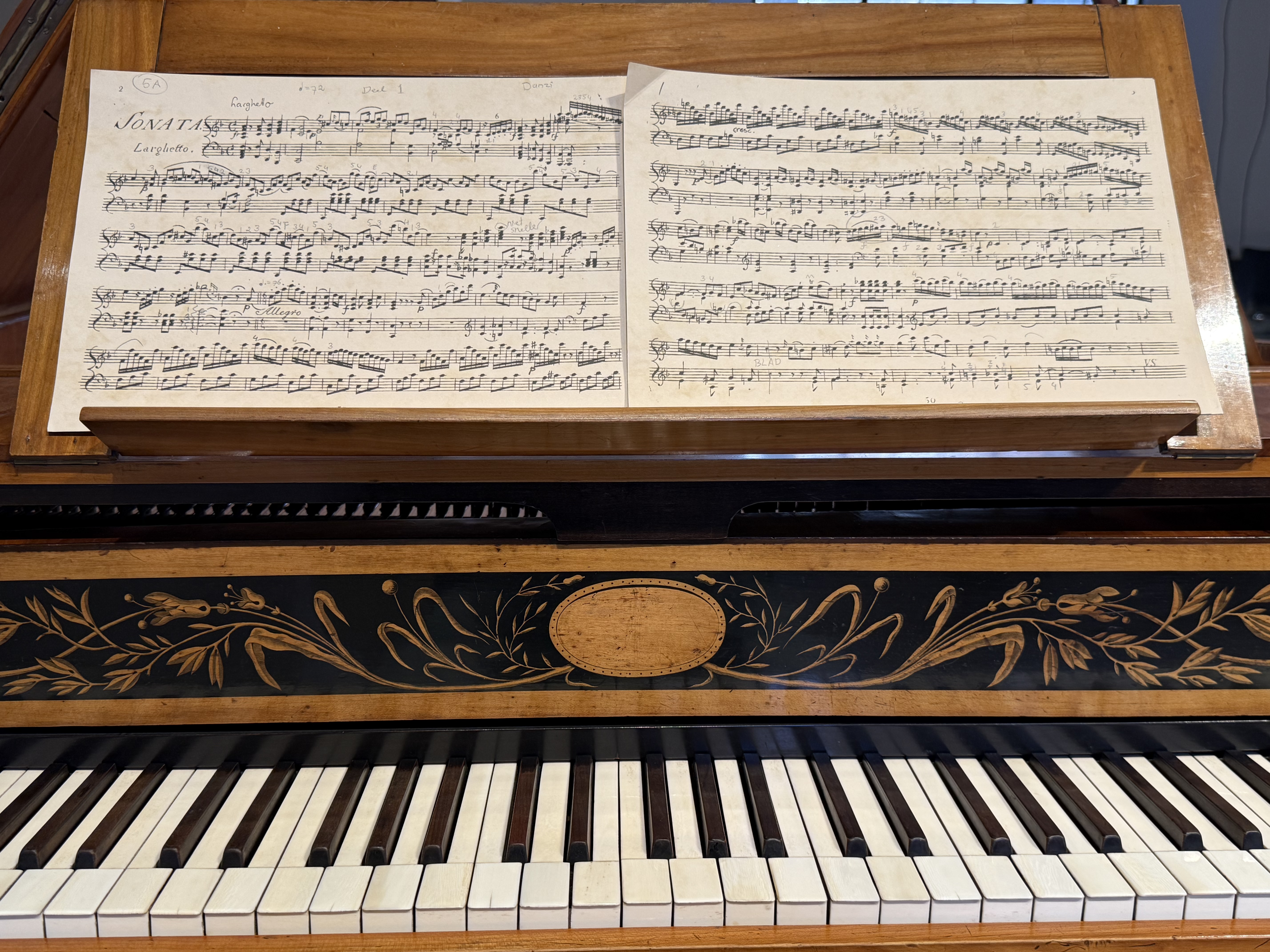
Click on the video above, featuring a song by Danzi/Marchand, to hear an original Louis Dulcken instrument from 1815.
27 mei 2025 BEIERS NATIONAAL MUSEUM - Paula Bär-Giese soprano & pianist
Madame Danzi (née Margaretha Marchand): "Dir nach 'oh' die ich liebe"- Louis Dulcken fortepiano 1815
🇬🇧
Margaretha Marchand: From Prodigy under Leopold Mozart to Celebrated Opera Star and Composer
In the eighteenth-century musical world, personal networks, court chapels, and musical families formed a tightly woven web. A remarkable example of this is the life of Maria Margaretha Marchand (1768–1800). Starting out as a young pupil in Leopold Mozart’s household, she grew into one of the most versatile musicians of her generation: a celebrated opera singer, virtuoso pianist, and gifted composer.
Raised in the Theatre
Margaretha was born in 1768 into a theatrical family (presumably in Frankfurt am Main, while her parents were on tour). Her father, Theobald Hilarius Marchand, was a prominent theatre director in Mannheim and later in Munich, while her mother, Magdalena Brochard, worked as an actress, singer, and dancer.
From a very early age, Margaretha appeared on stage in children's roles. She received her first serious vocal and musical training in Munich starting in 1778 from none other than Francesca Lebrun (née Danzi), one of Europe’s foremost sopranos and composers. This early connection would shape the rest of her life and career.
A New Musical Family in Salzburg
Following the death of his wife, Leopold Mozart regularly took talented students into his home in Salzburg to train them. Between 1781 and 1784, young Margaretha, her brother Heinrich (two years her junior), and their cousin Johanna Brochard (“Hännchen”) lived under his roof.
In April 1782, Leopold wrote enthusiastically about his new pupils. His own son Wolfgang was living in Vienna at the time, giving Leopold the opportunity to pass on his vast pedagogical experience to a new generation:
Leopold’s ambitions. He envisioned a bright future for both children. He hoped to make a great violinist and keyboard player out of twelve-year-old Heinrich, while preparing fourteen-year-old Margaretha to become a fine singer and an excellent keyboard player.
A broad upbringing. The children were treated not merely as boarders, but as full members of the household. They received a broad cultural and intellectual education and shared daily life, with all its joys and sorrows, with the Mozart family.
“Dearest Papa.” Surviving family correspondence reveals that Leopold cared deeply about his students’ ups and downs. In turn, the children became deeply attached to him; in her letters, Margaretha affectionately addressed her teacher as “dearest Papa.”
Breakthrough and Triumphs on Stage
Even after Margaretha (fondly called “Gretl” by Leopold) left his Salzburg home in 1784 to take up a post at the court in Munich, he continued to follow her career closely, regularly sending proud updates to his daughter Nannerl.
On November 19, 1784, Leopold reported a defining moment in her career. Gretl had sung splendidly and received the highest acclaim from both the Elector—who spoke with her personally afterward—and the assembled maestros. She had stepped in at the last minute as seconda donna opposite her former teacher Francesca Lebrun, after the original singer (Lisel Wendling) had declined the small part consisting of just two short ariettas. Despite the modest size of the role, Margaretha immediately made an unforgettable impression.
Following her official appointment as court singer in Munich in 1786, she became a celebrated interpreter of Wolfgang Amadeus Mozart’s major operatic roles. She excelled in demanding parts that required extraordinary vocal agility, including:
Susanna in Le Nozze di Figaro
Fiordiligi in Così fan tutte
The Queen of the Night in Die Zauberflöte
Donna Anna in Don Giovanni
Blonde in Die Entführung aus dem Serail
Marriage to Franz Danzi and European Tours
In 1790, Margaretha married the composer, cellist, and Kapellmeister Franz Danzi (1763–1826), brother of her former singing teacher Francesca Lebrun. Wolfgang Amadeus Mozart also took note of the marriage, writing to his wife Constanze on November 4, 1790: “Gretl has now married the brother of Madame le Brun, so she is now called Madame Danzi...”
Their marriage marked the beginning of a close artistic partnership:
Musical muse. Margaretha inspired her husband to compose numerous operas, concert arias, and vocal works tailored specifically to her impressive vocal range and technique.
International acclaim. Between 1791 and 1796, the couple toured Europe with impresario Domenico Guardasoni’s renowned opera company. As the troupe’s prima donna, Margaretha triumphed in leading musical centers such as Leipzig, Prague, Venice, and Florence.
Return to Munich. In 1796, they returned to Munich, where Margaretha was appointed prima donna of the court theatre and Franz became vice-Kapellmeister in 1798.
Original Compositions and an Untimely Death
At a time when women’s musical roles on stage were largely confined to singing or playing the keyboard, Margaretha stood out for her strong compositional gifts, which she had nurtured under Leopold Mozart. Although musicians and critics praised her works for their refinement and expressiveness, virtually nothing was published during her lifetime.
Her surviving works include:
Three Sonatas for Pianoforte and Violin (Opus 1), dedicated to her teacher and sister-in-law Francesca Lebrun.
Variations on the “Marche des Marseillois” (Opus 2) and several other sets of variations for piano.
Collaborative compositions, including the expressive second movement (Andante in F minor) of Franz Danzi’s Piano Sonata in F major (Op. 3).
This promising career was cut tragically short. In June 1800, Margaretha Danzi-Marchand died in Munich at the age of just 32 from a chronic lung illness. Her death devastated Franz Danzi so deeply that he withdrew from public musical life for several years. As a tribute to her memory, he arranged for much of her surviving music to be published posthumously between 1801 and 1802.
Musical Ties Across Generations: The Lebrun and Dulcken Families
Just how closely intertwined Munich’s musical circles were is further illustrated by their ties to the renowned Dulcken family of piano makers—and by the way this musical legacy was passed down across generations.
Louis Dulcken Jr. (1761–1836) learned the craft of piano building from his father in Hasselt, Antwerp, and Paris. From Paris, he moved directly to Munich in 1781 at the invitation of Elector Karl Theodor to serve as court piano maker. In April 1799, he married the German pianist and composer Sophie Lebrun (1781–1863).
Sophie was the daughter of oboist Ludwig August Lebrun and singer Francesca Lebrun—the very woman alongside whom Margaretha had achieved her breakthrough in 1784. When Sophie was orphaned at a young age, her uncle Franz Danzi took her under his wing and oversaw her musical education. Under his guidance, Sophie developed into an outstanding concert pianist and composer. At Sophie and Louis’s wedding in 1799, Margaretha Danzi-Marchand was present not only as a celebrated opera star, but also as a beloved aunt and guest of honor.
The musical training Franz Danzi imparted to Sophie continued to resonate at European royal courts for generations to come:
First-rate pianists. Sophie Dulcken-Lebrun passed her superb piano technique and musical education directly on to her children. Her daughters Louise Dulcken (1803–1857, married name Bohrer) and Fanny Dulcken (1805–1873, married name Bohrer) both became first-rate concert pianists of international renown.
Royal pupils. Louise Dulcken-Bohrer became court pianist in Stuttgart and piano teacher to the princesses of Württemberg—among them Princess Sophie of Württemberg, later Queen Sophie of the Netherlands (consort of King William III). Her sister-in-law Louise Dulcken (née David, 1811–1850, married to Sophie’s son Theobald Dulcken) settled in London, where she became piano teacher to Britain’s Queen Victoria. Thus, the musical lineage begun by Leopold Mozart, Francesca Lebrun, Margaretha Marchand, and Franz Danzi lived on at the foremost royal courts of the nineteenth century.
In the Footsteps of Dulcken
A musical dynasty of instrument builders in words and video
ANBI
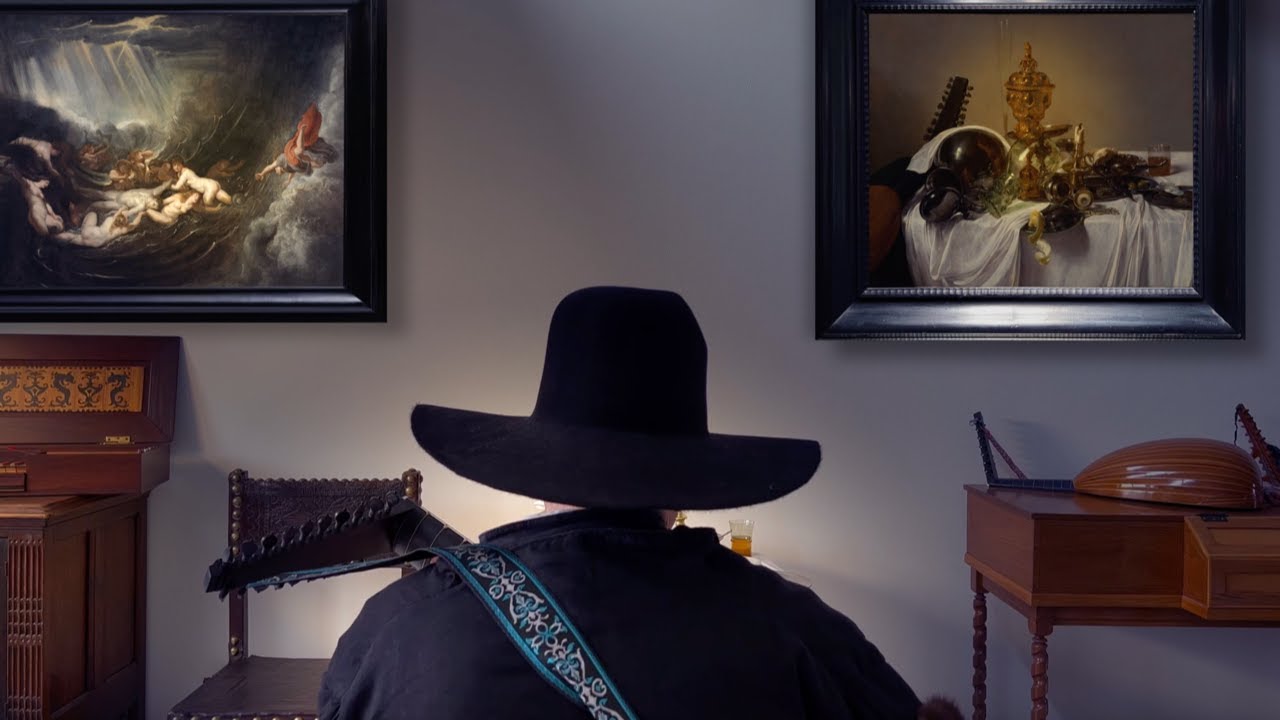
The Stichting Musick’s Monument produces Historical Art Productions. Pictures, music and text are integrated: You will hear music from the same period and the same area of origin as the visual materials; these are supplemented with explanatory text. From this combination evolves something like a Gesamtkunstwerk (a total work of art), a complete new way of digital art presentation since 2011.