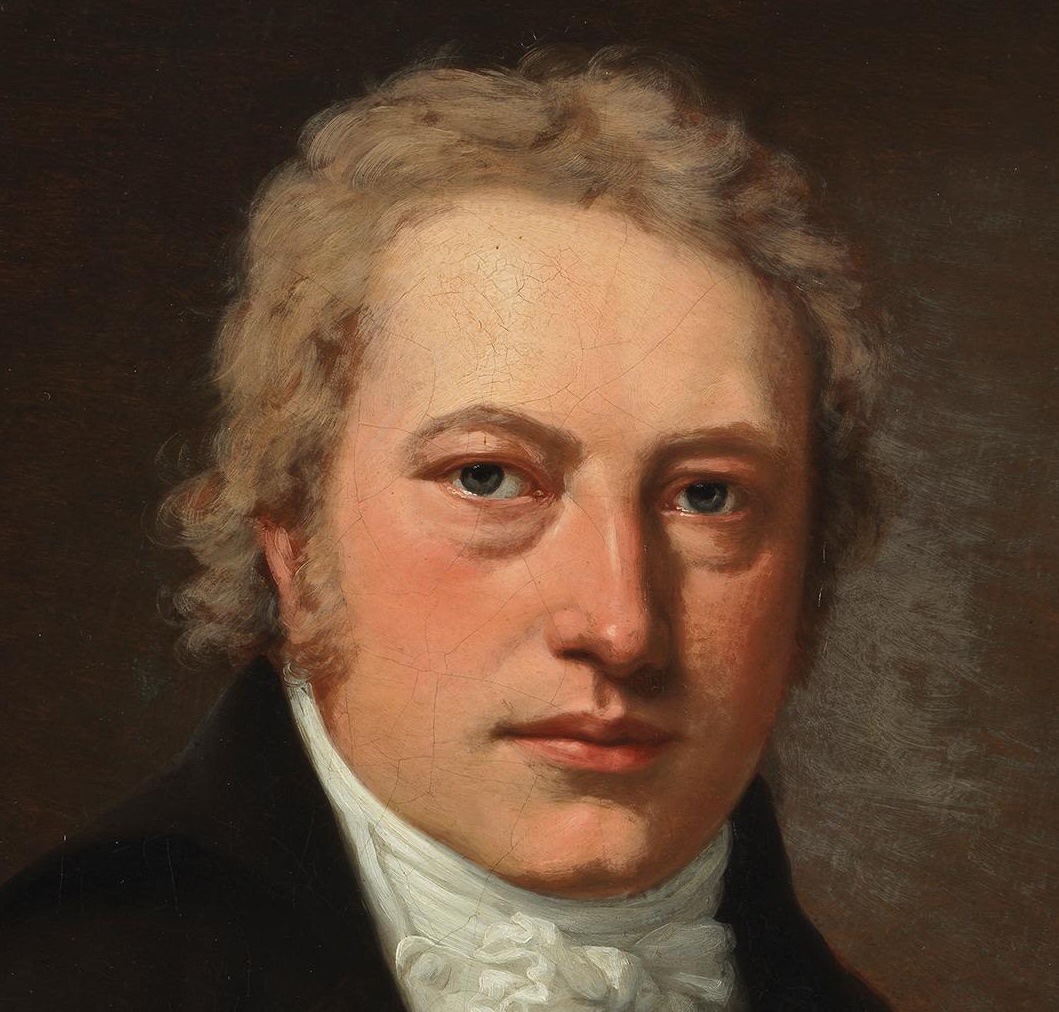
 Foundation Musick's Monument
Johannes Daniël Dulcken (1706 – 1757)
Hans Meijer - Henk Poelarends 
Evangelische Kirche Wingeshausen
Youth
Johannes Daniël Dulcken was born on 21 April 1706 in Wingeshausen, Grafschaft Berleburg (Germany)6*, into the family of George Ludwig Dülcken 7* and Margarete Ebenhardi Dülcken8*.

foto Dr. Johannes Burkardt
Taufeintrag von Johann Daniel Dülcken - ttranscription Dr. Johannes Burkardt
Eodem
Jungen sohn tauffen laßen, gevatter:
mein Schwager Johan Daniel Eberhardi
Inspector zu Siegen
mein Bruder Johan Leopold Dülcken, Prae=
ceptore 4 et 3ter Classis in Bremen
mein schwester Anna Catharina.
Ist genant
Johan[n] Daniel.
Wingeshausen photos Dr Johannes Burkardt & photographer Albert Ludorff 1894
The Riedesel rectory, with the Radebach on the left
Photographer Grobbel Fredeburg 1913 & photographer Albert Ludorff 1894
Georg Ludwig Dülcken - Wingeshäuser Pfarrhaus (1705/1914) - Dr. Johannes Burkardt
His grandfather, Eberhard Dülcken9* , married to Maria Leehr, was a minister in Berleburg from 1664. Eberhard was the salaried organist at the Nicolaikirche in Siegen. A year before Johannes Daniël's birth10* , his parents moved to Wingeshausen, where his father became a pastor in the Evangelical Church. The family lived in a Pfarrhaus built by Mannus Riedesel.
In 172411*, Georg Ludwig commissioned organ builder Johann Caspar Kirchner to build the first Wingeshaüser organ.

Invoice for the Casper Kirchner organ - transcripton Dr. Johannes Burkardt
Der Orgellmacher Caspar Kirchner Hat empfangen laut dem mit Ihm gemachten Vergleich, samt sei=Den Gesellen 228 r[eichs]th[a]l[e]r, tut
Vermöge Accords u[nd] quitt[ung] vom 14 t[en] may 1725, so H[err] Dülck[en] hatt.

His sons, Johannes Daniël and Carl Wilhelm Dülcken, started working as instrument makers12*.
"Ten Sterfhuyze van d'Heer Joseph de Jonghe, overleden Bailliu binnen de Stad van Dixmuyde, is er te koopen uyt'er hand eene zeer schoone Clavecine gemaekt door J. D. DULCKEN in het jaer 1723, lang acht voeten, bestaende in dry Registers, te weten: twee Unisons, ende eene Octave; zynde van onder tot boven zeer sterk ende aengenaem, het Clawier is van vyf volle Octaven, beginnende van onder met Fa, ende eyndigende boven met den zelven Toon, het Clawier is ook konstig ende kostelyk, de platte Тооnеn zwart, ende de Deesen met de Bemols wit, de Kasse, gereserveert de Tafel om de resonnantie niet te beletten, zeer schoon geschilderd ende verguld, met eene Schilderye in het Deksel om de Tafel te conserveren voor alle nattigheyd. Item aldaer noch te koopen een goed en wel geconditioneer Orgelken, zeer bequaem om in eene kleyne Kerke, ofte in een Concert. Die пае de zelve twee musicale Instrumenten gadinge hebben, konnen hun adresseren aen d'Heer Antbone Peellaert, Oud-Schepenen tot het voorzeyd Dixmuyde." Gazette van Gend, Waerschouwingen, 31/01/1771

There are sources that suggest that they helped build Kirchner's organ in 1724 and maintained it in the following years13*.
In October 1724, Pastor Georg Ludwig Dülcken from Wingeshausen and organist Johann Conrad Diehl from Netphen were called to Heinsberg to inspect the organ and identify its defects14*. From 1739 onwards, there were repeated complaints about the poor condition of the Wingeshaüser organ15*. The church archives mention that Reverend Dulcken cast the organ pipes himself in 173316*.

1823 - Eberhard Dülken (= Georg Ludwig Dülcken) , dahier verstorbener Pfarrer, soll im Jahr 1733 die Pfeifen gegossen…..
Orgel fotograaf Albert Ludorff 1894 - rekening foto Dr Johannes Burkhardt
Complete
-1823: Auf eine Umfrage der Superintendentur hin gibt der Wingeshäuser Pfarrer an, es sei eine Orgel mit 1 „Claviatur“ und Pedal mit 14 Registern vorhanden. Dazu schreibt er:
„Eberhard Dülken, dahier verstorbener Pfarrer, soll im Jahr 1733 die Pfeifen gegossen, und ein Bauer namens Schulze aus Becker-Haus von hier die Schreinerarbeit verfertiget haben. Sie ist jetzt in einem schlechten Zustande, und bedarf einer bedeutenden Reparatur. Von mehreren Orgelbauern, deren Namen aber nicht mehr bekannt sind, wurde sie bisher reparirt, und das Geld, aus Mangel an Fonds, von den Einwohnern erhoben.“ (Archiv des Ev. Kirchenkreises Wittgenstein, Generalakten der Superintendentur 143).
transcription Dr. Johannes Burkardt
On 17 December 1733, Johannes Daniël married Susanne Maria Knopffllin (Knopffel) in Sankt Goar17* met Susanne Maria Knopffllin ( Knopffel). (baptised 11 September 170618*).
1.
Baptism of Susanna Maria Knöpffel, daughter of Johann Conrad Knöpffel, Provisions Commissioner and Stift-Kellner in St. Goar, on 11 September 1706
(Archive of the Protestant Church in the Rhineland, Boppard, KB 149/1 (St. Goar ref.), p. 149.

Taufeintrag Susanna Maria Knöpfel - transcriptie Dr. Johannes Burkardt
Compleet
Den 11 t[en] [Novem]bris wurde Don[n]erstag Nachmittags zwisch[en] 12 u[nd] 1 Uhren
nach gehaltener
Beth=Stunde in öffentl[icher] Versam[m]lung getaufft Susanna Maria,
H[errn] Johann Conrad Knöpffels, Proviant-Com[m]issarii u[nd] Stiffts=
Kellners allhier Töchterlein. Gevattern waren Herr Oswald
Wollff, Nachgänger am hiesigen Hoch=Fürstl[ichen] Gesam[m]t-Rhein=
Zoll, u[nd] Fr[au] Maria Barbara, H[errn] Samuel Kellers, Stadt=
Lieutenants allhier ehel[iche] Hauß-Frau, wie auch H[errn] Pfarrers Geissel
Fr[au] Eheliebste von Wollroda
des H[errn] Vatters Schwester.*
* Die letzten 12 Wörter mit blasserer Tinte später nachgetragen.
Conrad Knöpfel, born in Wolfershausen in 1662, enrolled at the University of Marburg in 1680, became provisions commissioner at the Hessian fort of Rheinfels near St. Goar.
Conrad Knöpfel married Regina Magdalena Dirx on 29 April 1695. Conrad Knöpfel died before 1721.

Archive of the Protestant Church in the Rhineland, Boppard – Marriage of Conrad Knöpfel and Regina Magdalena Dirx on 29 April 1695 (KB 149/1, p. 255)
Burg Rheinfels at St. Goar
2.
Marriage of merchant and trader Johann Daniel Dülcken, son of the Reverend Dülcken zu Wingeshausen in the county of Berleburg, to Susanna Maria Knüpfelin, daughter of the late Proviant-Commissär and Stift-Kellner Johann Conrad Knüpfel, on 17 December 1733.
(For the marriage registration of 1733, it states: Archive of the Evangelical Church in the Rhineland, Boppard, KB 149/1 (St. Goar ref.), p. 287.)

2. Heiratseintrag Johann Daniel Dülcken und Susanna Maria Knüpfelin transcriptie Dr. Johannes Burkardt
Compleet
17. [Decem]ber * Sindt H[er]r Johann Daniel Dülcken, Kauff- u[nd] Handels=mann,
H[errn] Pfarrers Dül=
ckens zu Winches=hausen (sic!) in der Graffschafft Berlenburg
Ehel[icher] Sohn, u[nd] J[ung]fer
Susanna Maria Knüpfelin, des weyland H[errn] Johann Conrad Knüpfels
gewesenen proviant=Com[m]issarii u[nd] Stiffts=Kellers allhie,
nachgelasene Ehel[iche]
Tochter, copuliret u[nd] den 23 t[en] augusti hui[us] anni zum
I stenmal p[ro]clamiret word[en].
* Darunter Eintrag mit blasserer Tinte, aber von gleicher Hand: „16. hui[us] de infra. N[ota] B[ene].“

Maastricht, the Netherlands. View of the Markt (market square) and town hall. Drawing attributed to Jan de Beijer, ca 1740, in the collection of the Museum Boymans Van Beuningen, Rotterdam.
Maastricht
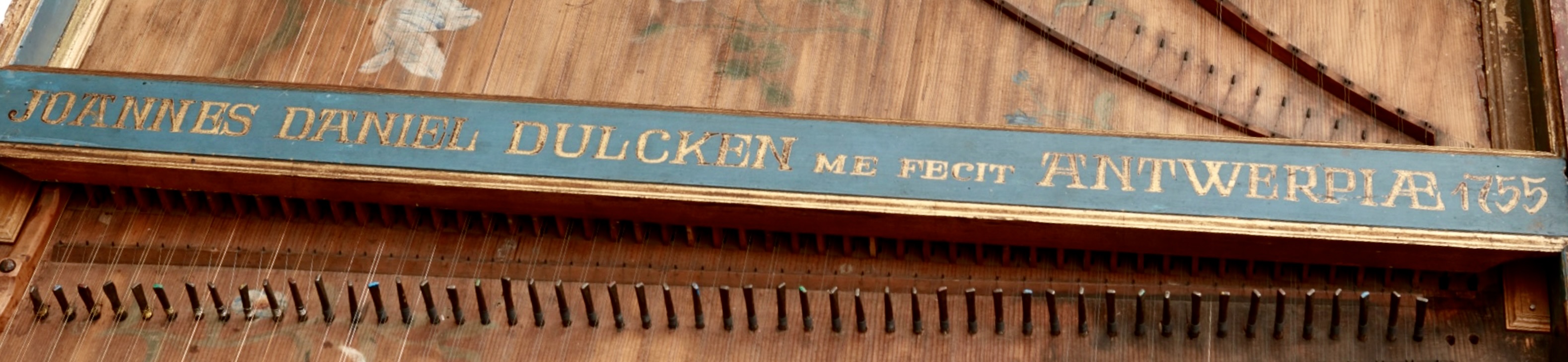
Around 1734 19* , the young couple moved to Maastricht, where their son Johan Lodewijk was born (baptised on 15 April 1735)20*. In October 173621* , they moved to a house on De Munt called “Het Gulde Cruijs” . The house was located between “Het Gulden Hooft” and “Den Swerten Rave”22*. They rented the house from Maria Catharina Bijen for a period of six years23*. In this large building, Daniël and his wife ran a grocery shop, a grutterij. Susanne probably ran the shop while Daniël spent his time building harpsichords24*. He is referred to as a merchant in various deeds. Their daughter Joanna Henriette was born there25*. (baptised 10 February 1737). The young family had financial worries in Maastricht, their debts were mounting, and around the turn of the year 1737/38, they left for Antwerp. They leave part of their household effects behind at “Het Gulde Cruijs”, which are auctioned off by the magistrate to satisfy their creditors. The magistrate appoints Johan Guichard as curator of “the desolate estate of the absent Jan Daniël Dulcken”26*. Creditors include his nephew Gerhart Prescher, who lent him 300 guilders, with his brother Jan Christiaan Dulcken as guarantor; the widow of Mayor Hesselt van Dinter, who lent him 600 guilders27*; and the Bijen family, due to nine months of rent arrears. A merchant from Amsterdam, Gerard Katers, also comes forward, claiming 410 guilders for the cost of goods and valuation fees28*.
On 20 June 1738, they entered “Het Gulden Cruijs” to appraise all the goods. The appraisal report29* shows that there were many tables and chairs. The shop inventory included a counter, a large iron balance with six scales, pewter measuring cups and a tobacco grinder. There are also many barrels, boxes, oil tubs and barrels of tobacco, etc. Two violins without strings and a trumpet are also found. It is clear that Daniël has taken everything related to the construction of harpsichords with him to Antwerp. Only a shaving bench remains behind.
The young family moved in 1738 in poor circumstances. Their creditors from Maastricht were breathing down their necks. They kept receiving letters from the trustee in Maastricht, and each time Daniël had to reply30*. This continued until mid-1740. It is not clear how the debt was repaid.

Antwerp
Daniël probably sees more opportunities in Antwerp than in Maastricht to sell his harpsichords. After a period of decline, Antwerp is beginning to recover and is the place where the Ruckers family built their leading harpsichords31*. It is clear that Daniël wants to continue this family tradition.
In 1740, the Dulcken family joins a small Reformed Church in Antwerp, the Olijfberg, where Johannes Diepelius is the pastor32*. In this Roman Catholic environment, the church community forms “a church under the cross” and is tolerated as long as it does not cause offence33*. This means that the small congregation often meets on Sunday mornings at the home of one of its members. In 174434*, Daniël was appointed “elder (ouderling)” by Rev. Johannes Diepelius35* and thus took charge of church affairs36*, but the minister and Daniël did not get along37*. On 26 January 1740, their daughter Maria Sofia was born, followed by their son Joannes on 10 September 174238*.
They probably paid off their debts quickly. There are indications that this happened with the help of the Magistrate, who saw the harpsichord maker with his unique harpsichords as a good addition to the business community in Antwerp. In 1742, he became a member of the St. Lucas Guild and was granted citizenship of Antwerp39*. His wife Susanne sold glassware for a glassworks in Ykenvliet40*. In 1743, he sold a harpsichord to the Archbishop of Cambrai in France41*. They moved to Hopland on 21 January 1746. He later bought three houses on the same street42*. Johannes Daniël Dulcken was a well-known figure in Antwerp.
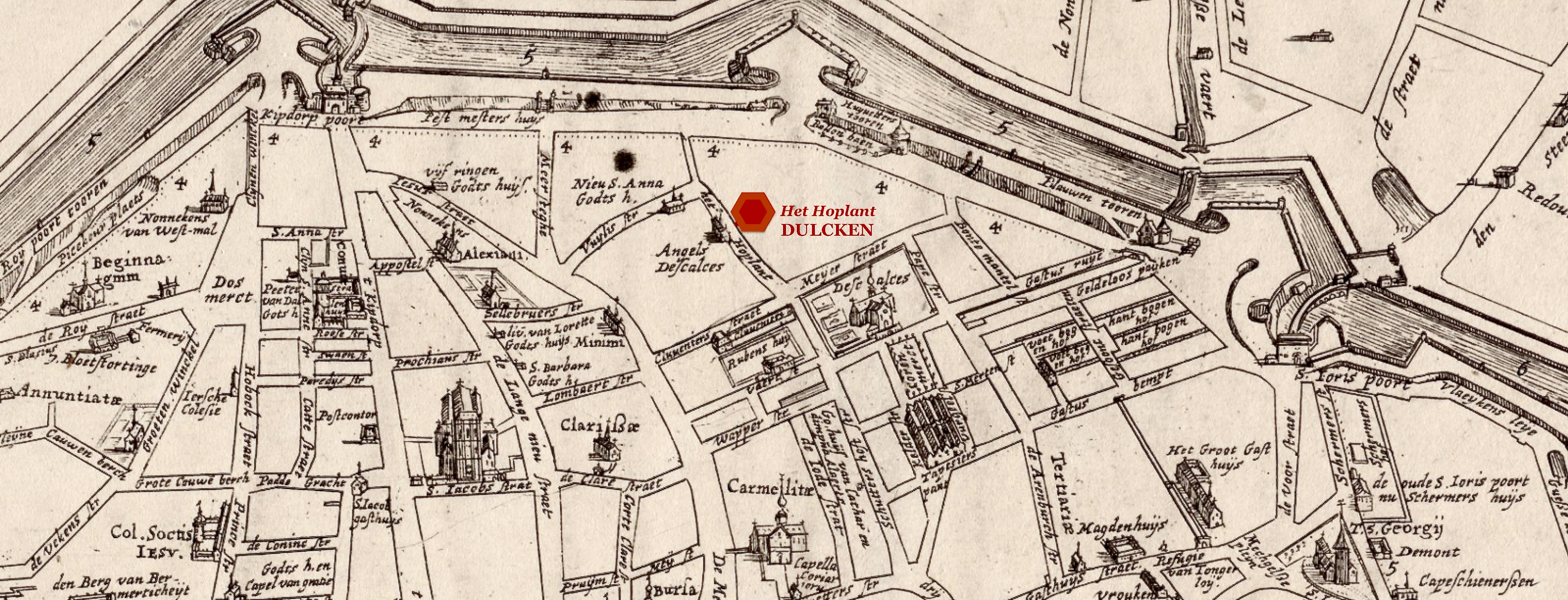


His workshop is located in Hopland43*, not far from Jodestraat, where Ruckers once worked. At the turn of the year 1749, he sails to London with two harpsichords and sells them there for 50 sterling44*.
Verthoont reverentelijck Jan daniel Dulcken, ingesetenen deser stad hoe hij ten verleden jaer 1749 is afgevaren van Ostende naar Londen in Engeland bij zigh hebbende twee clavesimbels uit het maken van welcke hij sigh binnen dese Stadt is geneirende. Dat de vertoonder in geselschap met Walter Schot , woonende binnen deze Stadt van het voorseijt Ostende is afgevaren….. Dat de voorn. Walter Schot op 15 janry 1750 onder onden stick de voorl. twee stucken clavesingers van de verhoorder heeft gecoght voor de somme van vijfftigh pond sterlinghs. (A.S.A. PK 841, Rekwestboek 1750, folio 50 -55.)
Harpsichords
Dulcken made harpsichords with single and double manuals, often with a range of five octaves and three registers: two 8' and one 4'. He decorated the soundboard with flowers and carved his initials into the rosette. About ten harpsichords made by him have survived45*.
Daniel was frequently ill46*. On 26 August 1751, Daniel and a sick Susanne made a will47* at their home in Hopland. Their daughter Johanna Henriette received a diamond cross with twelve stones, while Johannes Lodewijk received their wedding ring. All movable and immovable property was bequeathed to the longest living spouse. They were in regular contact with their family in Berleburg48*. In 1752, he receives news that his father has died.
On 23 May 175649* , their eldest son Johannes Lodewijk marries Catharina Koning in Amsterdam, where he makes and sells harpsichords in a workshop near the Kathuysers Kerkhof 50*.
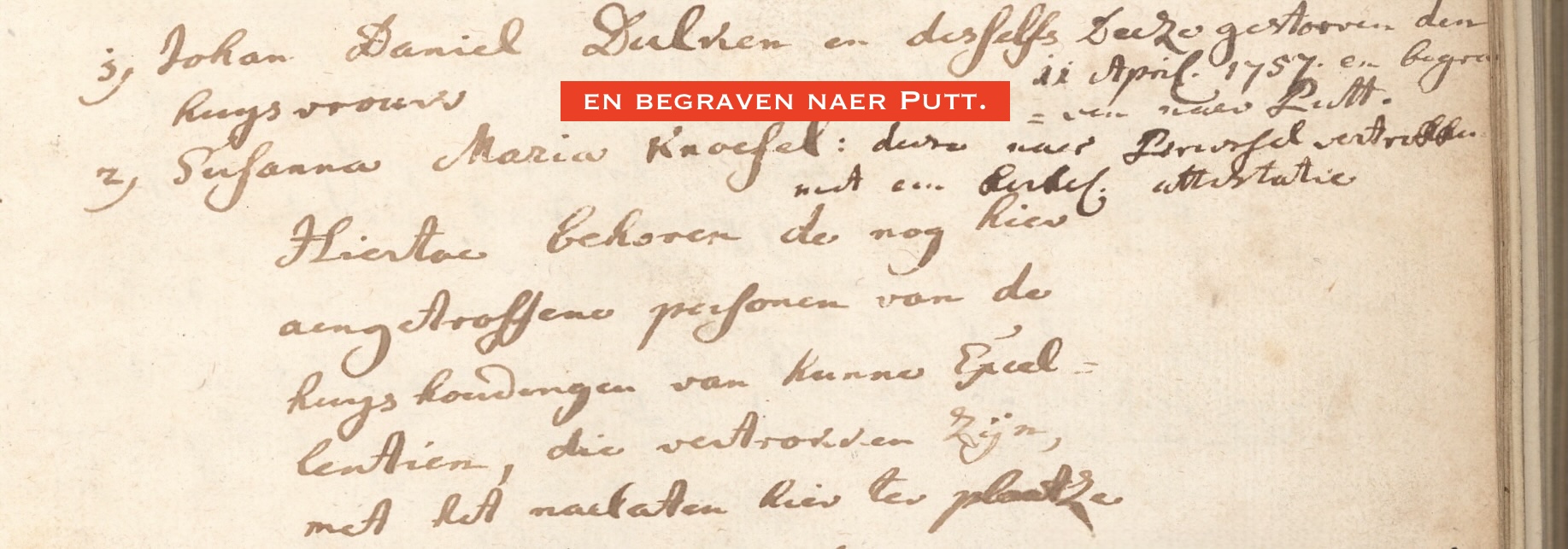
On 23 February 1757, the ailing Daniël adds an appendix51* to his will, stipulating that after his death, the tools and instruments needed to make harpsichords and organs52* are to be left not to the surviving spouse, but to his son Joannes Dulcken53*. Joannes had to support his youngest sister Joanna Elisabeth (born 3 February 1747)54*. Two weeks later, on Easter Monday, 11 April, Daniël died55*, Joannes was then 14 years old. Daniël was buried in the Putte cemetery56*.
Brussels
Widow Dulcken and her son Joannes continue the business, but things are not going well in Antwerp. Suzanne also sells glassware57*. In April 1763, they decide to move to Brussels. They already sell instruments there, but transporting them is expensive and time-consuming. Widow Dulcken asks the Magistrate of Brussels if they can obtain the same rights in Brussels as in Antwerp: citizenship and exemption from four taxes58*. She receives a negative response. Brussels does not recognise these privileges and does not want to make an exception for someone from outside the city, even if they claim to make unique instruments. They also doubt whether the Dulcken family actually has the rights they claim to have. Susanne Dulcken has stated that the harpsichords they make are the best in the Netherlands and are used at most concerts59*. Despite this negative response, they decide to sell their house60* and business in Hopland and move to Brussels.
Meanwhile, their eldest daughter, Joanna Henriëtta Dulcken , has married Johann Hermann Faber, a well-known painter61*.
In Brussels, things are not going as planned. Sales are too low, leaving the shop full of instruments. Susanne Dulcken decides to sell instruments in the towns around Brussels and therefore submits a request to be exempted from local taxes, so as not to ”haar niet in broodschaarste te laten (bread shortage)”62*. She does indeed receive exemption from the States of Brabant to sell her instruments in Antwerp, Leuven and surrounding areas.
Bankruptcy
Unfortunately, trade in Brabant also proved unprofitable. Between 1765 and 1768, things went wrong and it was eventually decided to close the business. In 1771 , Joannes was found in Amsterdam63* and Susanna went to Hasselt (Overijssel), where her eldest son Johannes Lodewijk had a business64*.
In August 176965* , Susanna became a member of the Reformed Church in Hasselt and went to live with her son in a stately mansion on Nieuwstraat66*. In 1776, when her son and his family leave for Antwerp, she stays behind in a small rented house67*. When she asks for support from the diaconate68*, she is expelled from the city as an undesirable69* alien and moves to Epe70*. In 1784, she leaves for Heerde71*, where she dies on 12 June 178972*.
The legacy of Johannes Daniël Dulcken.
Daniël Dulcken is described as a brilliant harpsichord maker and is considered the most highly regarded Flemish harpsichord maker of the 18th century73*. He continued the tradition of the Ruckers family. His unique method of building harpsichords was carried on by his sons Johannes Lodewijk and Joannes. His grandson Johannes Lodewijk, who worked at the court of Elector Karl Theodor in Munich, also continued the Dulcken tradition and is considered the greatest pianoforte maker of his time74*. Margarte Maddelung75* points to the Flemish influences in the work of Johannes Lodewijk:
“An zwei Stellen der Gehäusekonstruktion griff Dulcken auf Traditionen aus dem flämischen Cembalobau zurück, die er womöglich bei seinem Vater erlernt hatte. So folgt die Art der Resonanzbodenberippung und der Verbund der Wände mit dem Unterboden flämischen Bauprinzipien.
Ein weiteres Merkmal flämischer Bautradition liegt im Verbund der Wände mit dem Unterboden. Hier gibt es verschiedene Vorgehensweisen, die in unterschiedlichen Ländern bevorzugt angewandt wurden. In Flandern und England fand der Aufbau der Innenkonstruktion an den Wänden statt, erst nach dem Einleimen des Resonanzbodens wurde der Boden von unten aufgeleimt”76*.
Thus, through the instruments made by Johannes Lodewijk in Munich, the influence of Johannes Daniël Dulcken extended not only to the royal courts of Germany, but also to those of France, Switzerland, Italy and Russia.

Joannes Daniel Dulcken 1745 - Kunsthistorisches Museum Wien, Sammlung alter Musikinstrumente, 726
Johannnes Daniel Dülcken 1755 - (MK&G) - The Museum für Kunst und Gewerbe Hamburg
Oil painting by Frans Francken III, around 1650, glued into the lid.
Abraham, Sarah and Isaac, Hagar and Ishmael, and on the right, the destruction of the Egyptian army in the Red Sea.
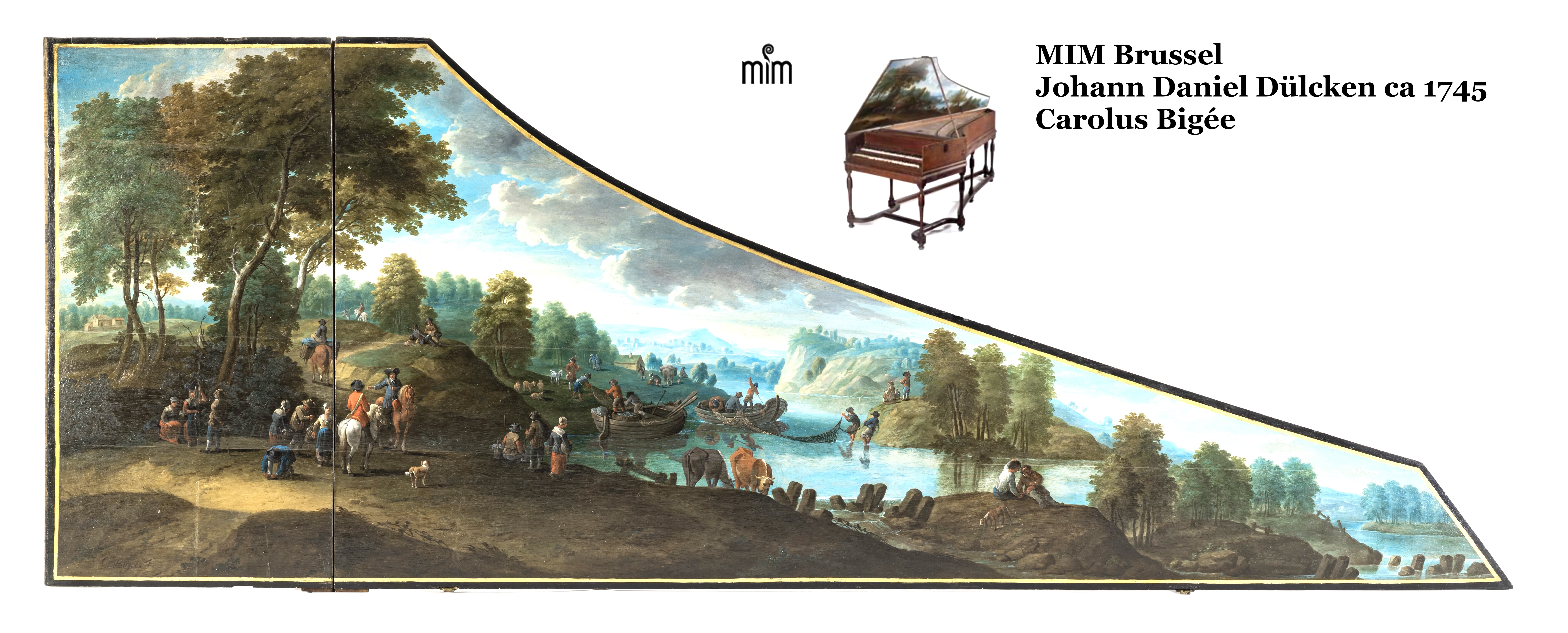

🇬🇧 The Secret Behind the Harpsichord Lid: From Herman Saftleven's Rhine Journeys to the Dulcken Dynasty
🇩🇪 Das Geheimnis hinter dem Cembalodeckel: Von Herman Saftlevens Rheinreisen zur Dulcken-Dynastie

Carolus Bigeé Schilder van Sijne Conste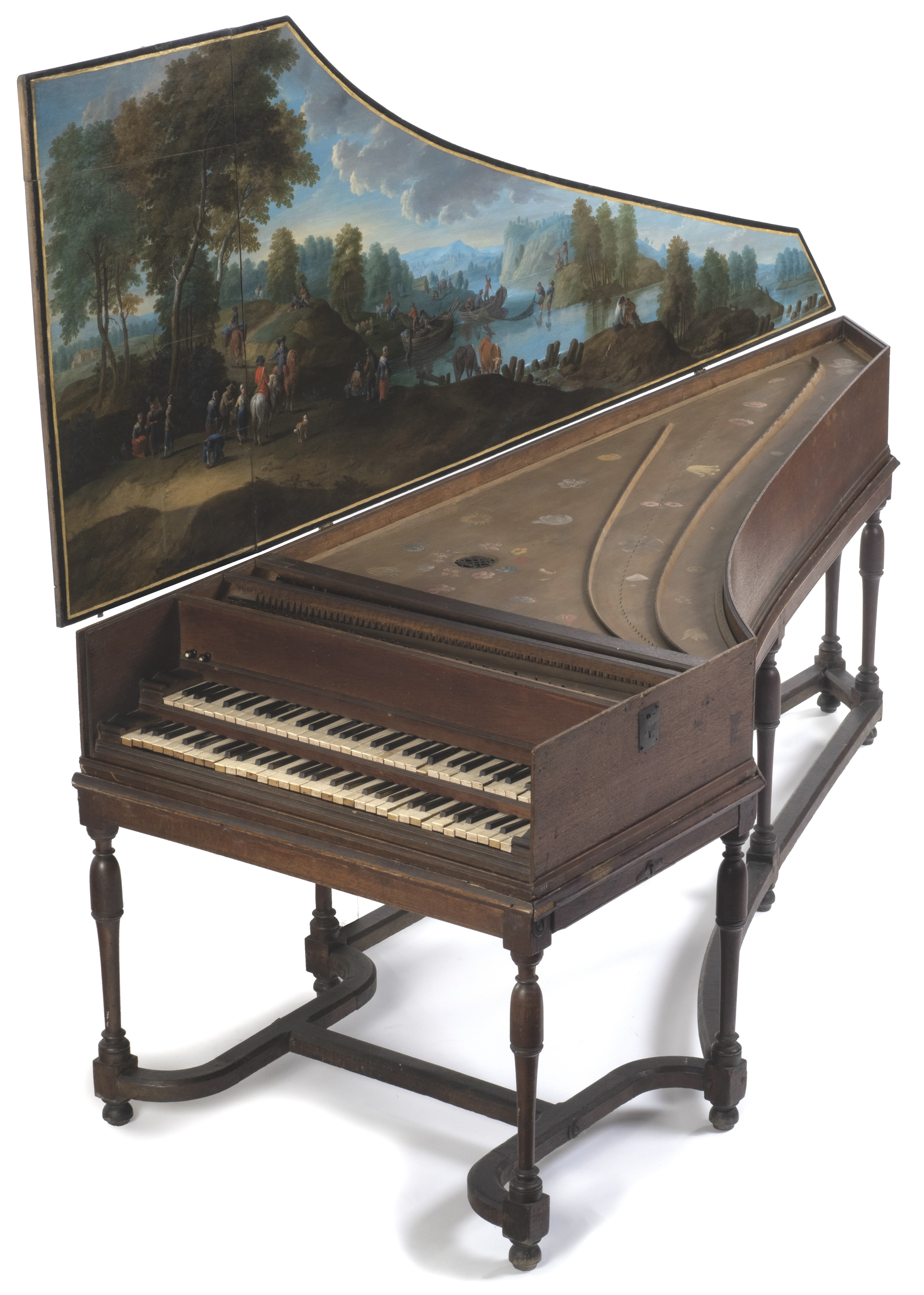

Dulken, J. Dan. ein Hesse, ließ sich zu Antwerpen nieder und machte schöne Flügel. Tagebuch seiner Musikalischen Reisen Durch Böhmen, Sachsen ..., 1773, p. 12

Snijders & Rockoxhuis
VIDEO
signed and dated lower left: J Horemans 1764 on the floor
Susanne Maria Knöpffel (Sankt Goar 11 September 1706 – † Heerde 12 June 1789)
Conrad Knöpfel, born in Wolfershausen in 1662, enrolled at the University of Marburg in 1680, became provisions commissioner at the Hessian fort of Rheinfels near St. Goar.
Conrad Knöpfel married Regina Magdalena Dirx on 29 April 1695. Johann Konrad Knöpfel died before 1721.
1.
Baptism of Susanna Maria Knöpffel, daughter of Johann Conrad Knöpffel, Provisions Commissioner and Stift-Kellner in St. Goar, on 11 September 1706.
2.
Marriage of merchant and trader Johann Daniel Dülcken, son of Pastor Dülcken zu Wingeshausen in the county of Berleburg, to Susanna Maria Knüpfelin, daughter of the late Proviant Commissioner and Stift-Kellner Johann Conrad Knüpfel, on 17 December 1733
Joanna Henrietta Dulcken 10 February 1737 & Jean Herman Faber 1734
Maria Sophia Dulcken 26 January 1740 – †17 January 1805
Joannes Dulcken (Antwerp 10 September 1742 – † 22 July 1775)
Joanna Eliezabetha 2 February 1747
Harpsichords and Harlequins: Commedia dell’arte and the Migration of the Dulcken Family (1764)
Klavecimbelbouw en Komedie: De Commedia dell’arte en de Migratie van de Familie Dulcken (1764)
Introduction
When you say Dulcken, you say Antwerp. A famous figure, but one with a very brief biography to date1*.
When “Dulcken” is one of your direct ancestors, you want to tap into all sources to create an honest picture of his life. Going back to the sources means checking what others have already found, sifting through meaningful archives2* and endlessly searching for clues on untrodden paths3*. The result is surprising new facts about his origins, family and work4*. Progenitor of master instrument makers5*.
1* Biografische gegevens in :
J. Lambrechts-Douillez, The History of Harpsichord Making in Antwerpen in the 18th Century, in Friedemann Hellwig (ed.), Studia organologica : Festschrift für John Henry van der Meer zu seinem fünfundsechzigsten Geburtstag. uitg. Schneider. Tutzing, 1987.
A.J. Gierveld, Het Nederlandse huisorgel in de 17e en 18e eeuw. Ver. voor Ned. Muziekgeschiedenis, 1977
A. H. Vlagsma ‘Overijsselse orgels uit de periode 1450 - 1825 Nat. Orgelmuseum Elburg, 2022
Dr. J.B. de Buy: De geschiedenis van den Brabandschen Olijfberg, Brussel 1960.
J. Lambrechts-Douillez, The History of Harpsichord Making in Antwerpen in the 18th Century, in Friedemann Hellwig (ed.), Studio Organ logica: Festschrift für John Henry van der Meer zu seinem fünfundsechzigsten Geburtstag.
A.J. Gierveld, Het Nederlandse huisorgel in de 17e en 18e eeuw. Ver. voor Ned. Muziekgeschiedenis, 1977
A.H. Vlagsma 'Friese orgels tussen 1500 en 1750' Fryske Akademy - Ljouwert 2003
Dr. J.B. de Buy: De geschiedenis van den Brabandschen Olijfberg, Brussel 1960
2* Biografische gegevens in :
J. Lambrechts-Douillez, The History of Harpsichord Making in Antwerpen in the 18th Century, in Friedemann Hellwig (ed.), Studia organologica : Festschrift für John Henry van der Meer zu seinem fünfundsechzigsten Geburtstag. uitg. Schneider. Tutzing, 1987.
A.J. Gierveld, Het Nederlandse huisorgel in de 17e en 18e eeuw. Ver. voor Ned. Muziekgeschiedenis, 1977
A. H. Vlagsma ‘Overijsselse orgels uit de periode 1450 - 1825 Nat. Orgelmuseum Elburg, 2022
Dr. J.B. de Buy: De geschiedenis van den Brabandschen Olijfberg, Brussel 1960.
4* Alle onderzoeksresultaten zijn verzameld op de website http://www.musicksmonument.com
5* Zijn zonen Johannes en Johannes Lodewijk en kleinzoon Johannes Lodewijk, Stadsklaviermacher in München.
6* Kirchenbüchern der reformierten Gemeinde Wingeshausen: KB 149/1, S. 287.
7* Onder andere: Website: FD Wittgensteiner Familiendatei
8* Georg Ludwig (geb.1679 – overl. 1752) en Margarete Ebenhardi ( geb.1684)
9* Eberhard Dülcken ( geb. ±1633 - 1699) op 19 oktober 1664 in Berleburg gehuwd met Maria Leehr,
10* Dr. Gabriel Isenberg, Orgellandschaft im Wandel, Die Geschichte der Orgeln in Wittgenstein. 2018, pag 5.
11* Transcriptie door Dr. J. Burkhardt , Kirchegemeinde Bad Berleburg 149.2
12* In 1771 wordt er in de Gazette van Gend een clavecimbel van J.D.Dulcken gebouwd in 1723 aangeboden.
13* Dr. Gabriel Isenberg, Orgellandschaft im Wandel, Die Geschichte der Orgeln in Wittgenstein. 2018, pag 5. Na de bouw van het Kirchner orgel zijn er in Wingeshausen geen officiële plannen en aanvragen meer ingediend. Het onderhoud is blijkbaar binnen de familie Dulcken geregeld.
14* Kreisarchive Olpei. W. 984
15* De kerkrekeningen van Wingeshausen omschrijven de werkzaamheden van 1739 tot 1823.
16* Dr. J. Burkhardt: onderzoek in Archiv des Ev. Kirchenkreises Wittgenstein, Generalakten des Superintendentur 143.
17* Kirchenbüchern der Reformierten Gemeinde St. Goar: KB 149/1, S. 287.
18* Tochter des Johann Conrad Knöpffel, Proviant-Commissair und Stift-Kellner in St. Goar, am 11. September 1706 (KB 149/1, S. 149).
19* Historisch Centrum Maastricht, 20.085B, laaggerecht Maastricht, 4753
20* Historisch Centrum Limburg, Doopboek Gereformeerde Kerk Maastricht.
21* Historisch Centrum Limburg, inv. nr. 4573 Vordering van Maria Catharina Beijen.
22* Het pand heeft nu als adres Muntstraat 26, (informatie monumentenzorg Maastricht).
23* Historisch Centrum Limburg, inv. nr. 4573 Vordering van Maria Catharina Beijen.
24* Historisch Centrum Limburg, inv. nr. 4573 Taxatierapport.
25* Doopboek Gereformeerde Kerk Maastricht.
26* Historisch Centrum Limburg, inv. nr. 4573 Aanstelling van Johan Guichard als curator.
27* Historisch Centrum Limburg, inv. nr. 4573 Vordering van de weduwe van Hesselt – Dinter.
28* Al deze documenten zijn te vinden in het Historisch Centrum Limburg, inv. nr. 4573.
29* Historisch Centrum Limburg, inv. nr. 4573 Taxatierapport.
30* Historisch Centrum Limburg, inv. nr. 4573: declaratie van de curator.
31* Over de familie Ruckers is veel gepubliceerd. Zie de literatuur onder het Wikipedia artikel: Ruckers - Wikipedia.
32* A.S.A. Par 173, Ledenlijst van de Kerk onder het Kruis, de Olijfberg te Antwerpen.
33* Dr. J.B. de Buy: De geschiedenis van den Brabandschen Olijfberg, Brussel 1960.
34* Door Dr. J.B. du Buy beshreven als: Een onaangenaam mensch op den Olijfberg”, blz 133
35* Het Utrechts Archief, inv.nr. 1401, Oud Synodaal Archief van de Nederlandse Hervormde kerk, Brief van Daniel op 5 juli 1753 aan Deputaten
"Elder" (dat is het gewone woord). ZEKER NIET ALDERMAN, want dat is een schepen in het burgerlijke bestuursorgaan (Magistraat). Het beleidsorgaan in een hervormde of gereformeerde kerk (in de 18de eeuw nog interchangeable) bestaat uit 1. predikant (dominee) 2. een aantal ouderlingen en 3. diakenen. Dit heet het presbyteraanse kerkorganisatie. Presbyteros = de oudste. Samen vormen ze het presbyterium, ook wel consistorie genoemd. Tegenwoordig kerkeraad. In protestant Church polity the governing body is generally threefold a 1. Minister (or pastor or teaching elder), 2. A number of ruling elders, and 3. deacons. The governing body is called 'the session'.
Kerkeraad - church council
Als je de formele bestuursfunctie van de ouderlingen wilt benadrukken, dan spreek je over 'the bench of elders'.
36* A.S.A . Par 173, Notulenboek van de Kerk onder het Kruis, de Olijfberg te Antwerpen.
37* Het Utrechts Archief, inv.nr. 1401, Oud Synodaal Archief van de Nederlandse Hervormde kerk, diverse documenten.
38* A.S.A. Par 173, Dopen en Huwelijken Hervormde Kerk 1735 – 1780.
39* Stadsarchief Antwerpen, PK. 449, Minuten van Secretaris P. van Zetten, 1774-1775, nr. 45 en 46.
40* Gazette van Antwerpen, 5 Meert 1756 en 14 Meert 1758
41* A.S.A. N. 270, J.M. Bervoets, 1740 – 1742, nr. 56.
42* A.S.A. Pk 854_001.
43* Gazette van Antwerpen, 5 maart 1756.
44* A.S.A. PK 841, Rekwestboek 1750, folio 50 -55.
45* Bijvoorbeeld in het Museum Vleeshuis in Antwepen.
46* Zie Dr. J.B. du Buy, blz. 133 - 150
47* A.S.A., N. 3086, J. Steenecruys, 1750 – 1751 blz. 326 en 327
48* FA. Berleburg, Poatbuch 7.
49* Archief stad Amsterdam: Trouwboek Sloterdijk: Akte van ondertrouw in de Gereformeerde kerk te Amsterdam Sloterdijk.
50* Amsterdamse courant » 07 sep 1756 - Art. 9 | Delpher.
51* A.S.A., N. 3092, J. Steenecruys, blz. 42.
52* Een aanwijzing dat hij nog steeds orgels maakt of herstelt
53* Dit gebeurt waarschijnlijk in goed overleg met Johannes Lodewijk, de oudste zoon. Drie maanden later is moeder Sususanne in Amsterdam als getuige aanwezig bij de doop van Susanna Maria, de oudste dochter van haar oudste zoon. Doopboek Gereformeerde Kerk Amsterdam.
54* A.S.A. Par 173, Dopen en Huwelijken Hervormde Kerk 1735 - 1780
55* A.S.A. Par 173, Ledenlijst van de Kerk onder het Kruis, de Olijfberg te Antwerpen.
56* Gereformeerden mochten niet begraven worden op de Rooms Katholieke begraafplaatsen in Antwerpen. Putte behoorde bij de Noordelijke Nederlanden.
57* Gazette van Antwerpen, 14 maart 1785..
58* Brussel, Alg. Rijksarchief, Raad van Financiën, nummer 4855.
59* In “La musique aux Pays-Bas avant le XIXe siècle” geschreven door E. Van der Straeten zijn afschriften van de originele documenten opgenomen. Gent – Brussel 1867 – 188 pag. 198 e.v.
60* A.S.A. Sr.1218, 1763, blz. 308 en 309.
61* A.S.A. Pk 854_001.
62* Brussel, Alg. Rijksarchief, Raad van Financiën, nummer 4855.
63* Archief Den Haag, Ledenregister Gereformeerde Kerk Dëen Haag
64* Henk Poelarends en Hans Meijer, Johannes Lodewijk Dulcken (1762 – 1776), eigen uitgave: Hasselt, 2024.
65* Archief Hervormde Kerk Hasselt, Ledenregister.
66* NL-ZlCO, 1365.1, inv.nr. 71, p. 156.
67* NL-ZlCO, 0058.1, inv.nr. 3217a, p.51.
68* Archief Hervormde kerk Hasselt: Notulen van de Kerkenraad van de Gereformeerde Kerk te Hasselt.
69* NL-ZlCO, 1365.1, inv.nr. 71, p. 156 e.v.
70* Archief Hervormde kerk Epe (Gld) Ledenregister Gereformeerde kerk.
71* Archief Hervormde Kerk Heerde: Ledenregister van de Gereformeerde Kerk Heerde.
72* Gelders Archief 0176, inv. nr. 884 begrafenisboek Nederduits Gereformeerde Gemeente Heerde.
73* Zie ook E. Van der Straeten, A.S.A., N. 3086, J. Steenecruys, 1750 – 1751 blz. 326 en 327
74* A.S.A., N. 3092, J. Steenecruys, blz. 42.
75* Margarete Madelung, Greifenberg 1998, p. 52 e.v., Die Biographie Louis Dulckens.
76* Margarete Madelung, Greifenberg 1998, p. 90, Die Biographie Louis Dulckens. Familiäre Traditionen.